


Two brothers bring gifts to God. … the Lord turned to Abel and to his offering. But to Cain and to his offering He did not turn, and it annoyed Cain exceedingly, and his countenance fell. Why should God look kindly upon one gift and indifferently upon another? Why should some be born lucky—what we might today call privileged—and others not? We are puzzled by this, and vexed by it, as was Cain. … and when they were in the field, Cain set upon his brother Abel and killed him. Afterward, Cain is driven “to the east of Eden,” the phrase that gives title to John Steinbeck’s 1952 epic of postlapsarian America.
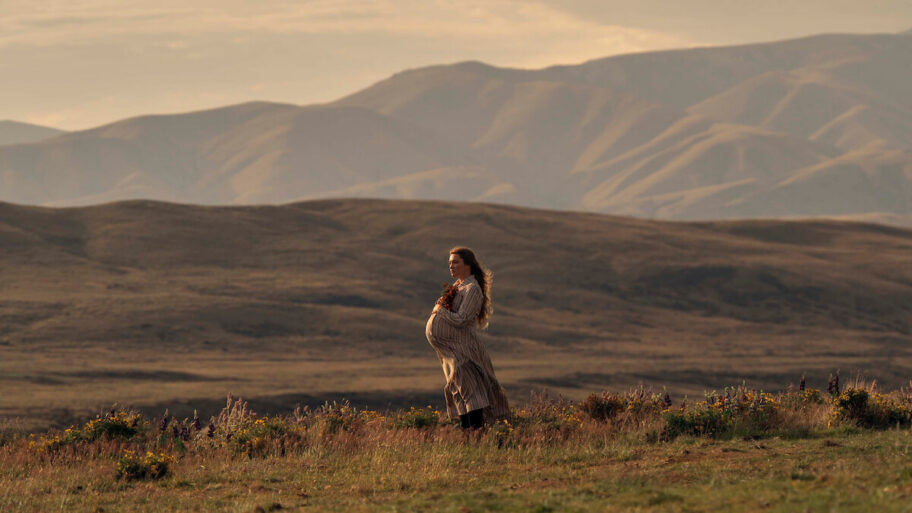
East of Eden is much in the news of late, on account of Netflix’s release, on October 1, of a serialized adaptation, written for the screen by Zoe Kazan. The show, which plods along unevenly for seven episodes—moments of genuine grace offset by blocks of wooden dialogue and crescendos and sunsets of maudlin production—mostly hews to Steinbeck’s text. It relays the story of two generations of the Trask family, each consisting of two sons, and their move from the antebellum East Coast to the unfulfilled promised land of California. At the center of the family’s unhappiness is the chaos caused by Cathy Ames, a mysterious woman whom one son marries, and who then abandons him and their children, changes her name, and opens a brothel in town.
Beyond a family history, Steinbeck’s novel is a meditation on brotherhood, envy, inheritance, and free will, and at its best Kazan’s adaptation is marked by magnificent depictions of brotherly love and affection. Midway through “Brothers,” the show’s first episode, the scenes of Adam Trask and Charles Trask (Christopher Abbott and Mike Faist, in a pair of strong performances) reuniting in their childhood home, their parents now dead, their youth now gone, mark high points of the series (alas, this in episode one). They cut each other’s hair, scrub the floor and table together, and grow close, a sweet depiction of the bond between two brothers.
The show is at its best in these portrayals of male closeness. Scenes throughout the series of men caring for each other, or men caring for children—especially children who aren’t their own, as is the case with Adam’s Chinese American servant, Lee (Hoon Lee), and the Trasks’ Irish American neighbor, Sam (Ciarán Hinds), who raise Adam’s children after Cathy’s abandonment—offer a social world that is healthier and more nourishing than the vicious fraternal war that Steinbeck depicts as an essential aspect of the human condition.
The show’s depiction of women, meanwhile, is far more hostile, a result of the story’s central female figure being the antagonistic and manipulative Cathy (Florence Pugh). Most scenes Cathy appears in showcase her shrewd villainy, leaving little room for the kinds of sweetness Kazan draws out in scenes of male fraternity and paternity (even if these are offset by plenty of male chauvinism, sexual depravity, and violence). Kazan attempts to give us something more than the “most vicious female in literature,” as The New York Times described Cathy upon the novel’s publication in 1952. She “reframes” Cathy, as Judy Berman writes in her review of the series in Time, in order that we might better understand the novel’s central antagonist. “It’s a feminist project,” Berman argues, “in that it takes for granted that a character who happens to be a woman should be given the same humanity as one who happens to be a man.” Reintroducing humanity into Cathy’s character, Berman concludes, “is not to vindicate or forgive her; it’s to make sure we genuinely see her.”
Kazan makes an effort. The difficulty is not that Cathy kills her parents, abandons her children, shoots her well-meaning husband, and murders the woman whom she calls her mother; cruelty is human enough. It’s that the explanations offered for her cruelty do little to make her a more complicated character. The backstory (Kazan’s Cathy was raped as a child, the show suggests) and the theory of patriarchy (Kazan’s Cathy rightly rails against the dearth of options on offer for a nineteenth-century woman) supply reasons for her antagonism without giving us much sense of a possible life beyond it.
But Kazan’s is a worthy goal: taking a great novel and “improv[ing] on some things,” as Kazan said to one reviewer. And indeed, choosing the path of good is one of the things the book’s about: taking what we inherit, and trying to improve upon that inheritance as best we can. Explaining the wrongs that shape a life, however, is different from deciding what to do about them.
This is also what the conversation surrounding the show has become about—what Zoe Kazan, whose grandfather Elia Kazan directed the original East of Eden film in 1955, has inherited, and what she is doing with it.
In 1952, shortly after directing Marlon Brando in A Streetcar Named Desire, Elia Kazan was called before the House Un-American Activities Committee and asked to name fellow Communists (he had been a member of the Communist Party until 1936); he gave eight names. His career continued to flourish—he would direct On the Waterfront in 1954 and East of Eden in 1955—but his testimony would emerge as a stain on his legacy, one that Zoe Kazan has been discussing in interviews about her Netflix adaptation.
In a recent profile for New York, Alison Davis nudges Kazan to consider her family’s history, and the ways that history weighs upon her adaptation of East of Eden. “[Elia Kazan’s] actions became a family burden,” Davis writes, and “his damaged reputation metastasized into his granddaughter’s burden, and the byzantine legacy became part of her pitch for her version of East of Eden.” A book largely about inheritance is now an opportunity for Kazan to reckon with her own. “I don’t think it was helpful for me to be burdened by my family’s connection when adapting this,” Kazan says. “I had to put it aside.”
Putting that burden aside may have been necessary to write the adaptation. Whether it suffices as a reckoning with the advantages that connection afforded her is another question. Writing in his Substack newsletter, Freddie deBoer, responding to Kazan’s story, and to Davis’s sympathetic profile, sees a nepo baby who has benefited from her grandfather’s fame and influence and who is now reflecting upon the spoiled riches she inherited. “Thousands of victims of McCarthyism did not have the opportunity to put their burdens aside,” DeBoer writes. “And ultimately, if you want to be a force for equality and justice, you have to do the work to understand how lucky you are.”
Zoe Kazan is not responsible for her grandfather’s choices, but her adaptation does raise questions about the legacy of them. What responsibilities are born of great privilege? And what if some of that privilege is marked by mistakes or misdeeds? These are questions that the novel and Kazan’s adaptation of the novel explores directly. The Trask family fortune, amassed by the patriarch Cyrus Trask, was stolen from a veterans’ fund that Cyrus managed—ill-gotten gains great enough to support his descendants.
What does one do with such an inheritance? Buy a mansion in California, hire a servant, and never work a day of your life, Cyrus’s son decides. Keep that sin a secret until, years later, you feel ready to talk about it. In Kazan’s adaptation, when Lee mentions Adam’s father, Adam says to him: “Did you know he was a thief? He stole from army veterans. That’s how he made his fortune. It took me a while to believe it, but it’s true.” Lee looks at Adam. “So the most rigidly honest man I’ve ever known has lived his whole life on stolen money?” Lee asks, and then laughs. Adam does too, and they both move on.