


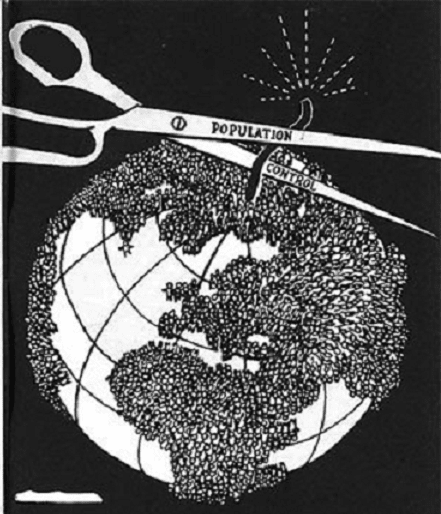
His prediction is everywhere, dominating the zeitgeist: current birth rates will lead to the end of civilization. Fertility rates keep getting worse. Mass famine and economic collapse are coming.
I could be describing Elon Musk, who famously believes “low birthrates will end civilization,” or I could equally well be describing Paul Ehrlich, who died on Friday. In his 1968 bestseller The Population Bomb, and his copious late-night TV appearances, Ehrlich warned about the catastrophic effects of population. Ehrlich worried about rising population, and Musk worries about falling population, but in both cases the problem is similar: a provincial, me-first analysis of who matters and why.
In The Population Bomb, Ehrlich’s influential tract penned at the dawn of modern environmentalism, he made two mistakes. First, he mistook sheer population size for the main driver of ecological crisis, when in fact environmental damage depends on patterns of consumption, industrialization, and resource use, which were and remain far greater in wealthy societies. Second, he underestimated humanity’s capacity for technological and institutional innovation, particularly in agriculture, where new methods of production dramatically increased yields and complicated his prediction of imminent catastrophe. These mistakes had real consequences: for example, they led to Ford Foundation population policies that laid the groundwork for sterilization abuse in India.
For all his flaws, Ehrlich viewed population as a global problem which required global solutions. “Our position requires that we take immediate action at home and promote effective action worldwide,” he wrote in The Population Bomb. Not so for Musk and his allies like JD Vance, who focus on the U.S. and on European nations with historically low birth rates. In recent historical perspective, this concern about Western population is a significant development. It leads Musk and Vance to oppose immigration. But declining immigration, more than the declining birth rate, is why the U.S. population increased by only 0.5 percent last year, down from 1 percent in the prior year, and it might decrease this year for the first time ever.
Ehrlich conflated population with environmental impact, even in poorer countries, so he promoted population control rather than resources and agricultural advancements for developing nations. Musk conflates birth rates with economic impact, even when migrants risk life and limb to come to the U.S. and contribute to its economy. Both are similar, however, in their failure to exercise moral concern—to really see those whom we should care about and to consider how we can help. But these questions aren’t just about the present; they’re about the future, about who will come to exist and what their lives will be like. To build a better future in the face of these prophecies of collapse, we must interrogate those who would narrow our moral concern for the not-yet-existent: first Musk’s parent-centric approach to future generations, and then the optimism of the environmental movement which Ehrlich helped catalyze but which now rejects his legacy.
AI doesn’t have children, but Elon Musk treats it as if it has more claims on the future than many humans do. Responding to Amanda Askell, an ethicist at Anthropic, he recently claimed that parents alone have a stake in the future, insisting that only parents can even understand his claim. By embracing the narrow first-personal perspective of parents, Musk rejects global citizenship and shows a profound lack of moral concern.
What is moral concern? Askell puts it succinctly: “I care a lot about people thriving, even if they’re not related to me.” She’s continuing an old tradition: according to Thomas Aquinas, drawing on Aristotle, to love someone is to want what’s good for them for their own sake. This desire forms the basis of friendship and family, but it’s important even when a relationship is impossible or irreparable. As with the universal love sometimes called agape, Aquinas’s model of love does not depend on any features of the beloved. You can’t earn being loved for your own sake. Or, as the tee shirt says, “God loves me and there’s nothing I can do about it.” The same goes for our concern for our fellow humans.
Musk is making a profound statement about moral concern when he says that the non-parents among us don’t have a stake in the future. He means that those without children cannot have moral concern for future generations. According to Musk, moral concern is inside-out, not outside-in; it comes only from you and your immediate surroundings, as if moral concern requires an access point to hook up to the connections we might have with humanity’s descendants.
In many ways, moral concern for future generations is the simplest form of moral concern, because the unborn are not citizens, taxpayers, or workers. Musk restricts this moral concern to personal connections: I can care about the future only if I helped create it. But this attitude to moral concern threatens to tear apart our society; we need more moral concern of all stripes, not fewer. Aquinas thinks that love is the foundation for all other kinds of moral virtues. We can’t be good people without wishing the good for others for their own sake.
Musk is making a profound statement about moral concern when he says that the non-parents among us don’t have a stake in the future.
These questions relate to a branch of philosophy called population ethics, which originates in the work of Derek Parfit. His 1984 book Reasons and Persons generated whole literatures, which continue apace almost half a century later. In one of his most famous claims, Parfit denies that there’s a moral difference between someone who’s far away from me in space and someone who’s far away from me in time. Imagine I shoot an arrow into a forest and it injures someone. It would be absurd for me to claim that, just because the person was far away from me, I didn’t do anything wrong. But now imagine that I leave a shard of glass in the woods and one hundred years from now a child steps on it and cuts their foot. It would be absurd for me to claim that I didn’t do anything wrong just because the child is temporally far away from me and wasn’t even born when I left the glass. I clearly caused this child to suffer, so it was negligent of me to leave the glass.
One way to describe these cases is as a failure of moral concern. Those who are hit by the arrow and step on the glass are far away from me somehow, the one in space and the other in time. But what I do affects both of them. I don’t need to be related to them in any way to affect them profoundly. When I hurt them, I am not looking out for what’s good for them. Crucially, wanting the good for someone else doesn’t require knowing who they are or anything about them. All it requires is that, whatever is good for them, I should want it and act to promote it. To be clear, in many cases it’s genuinely unclear what’s good or bad for someone. But being hit by an arrow and stepping on a glass shard are unambiguously bad. We don’t need to agree on the list of good and bad things, or even on an overarching moral theory, to agree on some basic things that are not in people’s interests.
Here lies a central problem with Musk’s approach: for Musk, it doesn’t make sense to care about the future if I don’t have kids, because I need some preexisting relationship with those affected by my actions in order to have moral concern. Put like this, his view is obviously solipsistic and troubling. What leads me to care about where I put my shards of glass (or my nuclear waste, in another example popularized by Parfit) is that they can really hurt someone. I want the good for everyone, so hurting anyone means I’ve failed. As Aquinas acknowledges, I can love everyone and nonetheless help some people more, because I have a special relationship with them. But the moral concern needs to come first; then I can make tough decisions about what to do and how.
Parfit denies that there’s a moral difference between someone who’s far away from me in space and someone who’s far away from me in time.
Now it’s time to take the final step: not having a kid can come from moral concern. Musk denies that those without children can even possibly have moral concern about the future; but what I’ve said so far should lead us to think that moral concern about the future can justify not having kids. To be clear, when I don’t have a child, I cannot have moral concern for that specific child; things can’t be better or worse for the non-existent. Yet, as we’ve been discussing, moral concern must not require an existing relationship, and I must be able to have moral concern for those I don’t know and who might not even be alive now. It’s only a small jump from not leaving the glass shard in the woods, which would hurt someone born after my lifetime, to not exposing a new being to the harms of a climate crisis, which will only intensify when I’m no longer around. It’s a matter of significant debate how bad the climate crisis will get, and I don’t mean to presuppose an answer. Still, for someone who fears the worst, moral concern stemming from the climate crisis is a very fitting reason not to have a kid.
I mention this because, after environmentalists abandoned Ehrlich in the 1990s and rightly stopped focusing on population, many developed a surprising point of agreement with Musk. “Having a kid is a vote for the future,” Musk said in 2024. “It is the most optimistic thing that somebody can do.” As Ezra Klein similarly remarked in 2022, “To bring a child into this world has always been an act of hope.” He concludes: “If the cost of caring about climate is to forgo having a family, that cost will be too high.” Naomi Klein (no relation), in her landmark 2014 book This Changes Everything: Capitalism vs. the Climate, observes that “the persistent positing of population control as a solution to climate change is a distraction and moral dead end.”
Ezra Klein agrees with Naomi Klein’s focus on systemic change rather than population control, and I agree with her too. But the Kleins’ approaches each risk removing moral concern from our reactions to the climate crisis, and that’s what worries me. We need responses to all of our problems—climate crisis, hunger, healthcare, housing, and more—which foreground moral concern. Working for systemic change to alleviate the climate crisis can come from moral concern for one’s own kids; and it can also lead one to have no kids or fewer kids, out of concern for those who will or would be impacted by the climate crisis. We need to move beyond Ehrlich’s failure of moral concern, which overburdened poorer countries and ignored richer ones, to bring moral concern to the question of whether to have kids in affluent countries. Our answers will differ; but moral concern is the path forward to asking the right questions.
For an approach to the climate crisis which foregrounds moral concern, one place to look is in the work of Jade Sasser. As she writes: “Climate-driven kid questions demand reflecting on what our responsibilities are to each other, not just to our own children and families if we have them but also to our communities and the broader society.” Start with responsibilities; this is the outside-in model of moral concern that’s the exact inverse of Musk’s. How can we wish the good for others for their own sake? Although that sometimes means starting with our families and immediate surroundings, the problem of future generations is not one of those cases. This is a problem that requires thinking big, dreaming big, and welcoming the moral concern of everyone who can muster it. When we wall off our moral concern and those of others, the world is a darker place, for ourselves and for any descendants we—or anybody else on earth—have.