


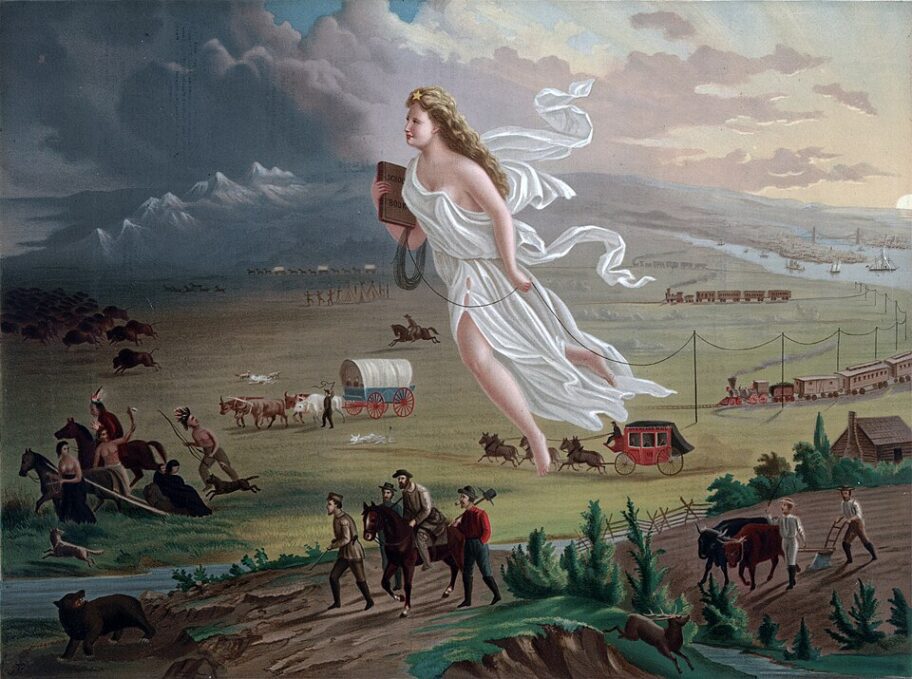
Tisa Wenger teaches American religious history at Yale Divinity School. She is the author of three books, including We Have a Religion: The 1920s Pueblo Indian Dance Controversy and American Religious Freedom (University of North Carolina Press, 2009) and Religious Freedom: The Contested History of an American Ideal (University of North Carolina Press, 2017). Her new book, Spirits of Empire: How Settler Colonialism Made American Religion (University of North Carolina Press, 2026), applies the controversial concept of settler colonialism, most often used to describe foreign empires (or, by some, Israel/Palestine), to the American past. I spoke with her earlier this year about the Indian past, the concept of settler colonialism, being a white scholar of Native studies, and more.
Mark Oppenheimer: What is your book about?
Tisa Wenger: It is about the intersection of religion and settler colonialism in early America, and it makes the argument that American religion, both the category of religion and the practices and traditions that go by that name, developed on settler colonial grounds, in a settler colonial context, and was fundamentally shaped by the settler colonial process that we call Western expansion. I write in the book that the United States was, from the start, a new kind of empire built on a governing model that scholars call settler colonialism.
MO: What is settler colonialism?
TW: Settler colonialism is the form of colonialism in which settlers from another place, representing a foreign empire perhaps, displace native peoples and their structures of governance. So it does not refer to any immigrants or migrants, but it is where local indigenous forms of governance and control over land get displaced and pushed away. This model involves the displacement of Indigenous peoples and polities from their lands, replacing them with white settlers and a new government that privileges them.
MO: One of the criticisms that I could imagine coming at the book is that there are no indigenes, that the natives themselves were often settler colonialists who displaced or eliminated prior peoples. Does that complicate the question of settler colonialism?
TW: It is true that people migrate. That’s been a big part of human history everywhere. I don’t think that the same patterns of settler colonialism existed prior to European settlement here. There were conflicts between groups, but in my understanding of history, those conflicts happened in different ways. Certainly they were not a kind of civilizational displacement that was supported by a foreign empire. There were wars between neighboring nations, but sometimes groups shifted in territory. That seems to me more similar to wars between neighboring nations in Europe, Africa, or in other parts of the world where nations think of themselves as peers or neighbors and they’re in conflict. Sometimes they’re in conflict over resources that they both want, but they’re not completely displacing each other or aiming to eliminate the other.
The concept of indigeneity is very complicated, you’re right. Who gets to count as indigenous? This is a fraught question now with the Israel-Palestine conflict, in which both sides claim indigeneity to the land. It seems very clear to me that in the Americas, whether you believe that these native people have been here forever—I mean, who’s ever been anywhere forever?—that native nations were the first humans here. They had developed their cultures, civilizations, traditions, and way of being in the world in relation to this land. I think indigeneity and who identifies as indigenous actually is a category that has developed historically in relation to being colonized.
Certainly in the United States, there was no sense of being Indigenous people of this land prior to colonization. You gain a sense of alliance and commonality structurally in relation to a colonizing power. The word “indigenous” is a broad category that has grown out of pan-indigenous connections across different parts of the world. There has been a sense of shared indigenous struggle and indigenous traditions in other places that have seen themselves as structurally subordinated indigenous people in relation to colonizers who came from elsewhere. I do think it’s a political category that has emerged in relation to colonization. I think like any such political category that emerges in history, the boundaries of it are contested.
MO: There is a school of thought that it’s a flawed category precisely because nobody is truly indigenous. From this perspective, the idea that there’s a clear distinction between colonizer and indigenous people is challenged, since the indigenes were often prior colonizers. In that sense, no one’s really indigenous? If some of the native groups were the ones here because they had obliterated prior native groups, we wouldn’t necessarily know, because they didn’t have written languages, and they were not historiographical in the sense that some of the colonizers were. And it would complicate the question of their indigeneity. It wouldn’t complicate whether wrongs were done to them, but it would complicate the ethical system in which there’s a bad guy and a good guy.
TW: I don’t really buy that. I see the point. I don’t think that there’s any kind of pure culture in which everybody’s good, and there’s no good people on the side of the colonizers and no bad people on the side of indigenous. People are complicated, messy. I think that one of the tricky things about writing a book like this is precisely what you’re pushing me on. For me, I think the question is how to write a book in which everybody in the book is thoroughly human.
MO: There are no saints.
TW: Maybe there are pure villains, but pure villains are vanishingly rare. Most people are struggling through. They might get drunk on power sometimes. They might be seriously racist, prejudiced against a certain other group of people. But I think most people in this book and in the world are trying to do good in the world as they see it. Sometimes good in the world as they see it is accumulating as much wealth and power for themselves.
MO: Or making more Christians.
TW: Certainly they see themselves doing good in the world. So [the task is] how to write a book where everybody in the book is really thoroughly human, and, at the same time, accounts for what I see as egregious systemic violence and structural oppression that also then doesn’t flatten out the possibility of meaningful agency on the part of those who are on the underside of that. There certainly have been works in native history that have talked about colonization and colonialism.
MO: How is it different if you talk about it as settler colonialism versus just colonialism? I’ve heard some people draw the distinction between settler colonialism and extractive colonialism. The latter is when you go in and just take their resources, their minerals, and the former is when you go to stay and displace them.
TW: Yes, exactly. I think that there are different forms of colonialism, and settler colonialism is a more specific term that I think more accurately describes what happened in the United States. Settler colonialism and extractive colonialism are also ideal types that overlap. I think settler colonialism is also extractive.
The French in the early colonial period in the Great Lakes region, in the eighteenth century, were more an extractive colonialist model. There were some settlers, but they were the settlers who came for the most part, with a few exceptions, to participate and benefit from the fur trade. The fur trade was an extractive colonial model, but it was one that also, for a century or so, benefited a lot of Indigenous nations. Most of the French who settled, and this is many of the people that the British and then the white Americans found when they arrived in Michigan and the Great Lakes region that so much of this book is about, did not try to fundamentally change or control Indigenous nations. They blended into them. They married into them. They traded with them. And again, that’s not to say that the French empire wasn’t also violent. The French empire also worked differently in different times and places. In the eighteenth-century Great Lakes, it was mostly extractive colonialism.
In the Canadian provinces north and to the west of the Great Lakes, there’s a Métis nation of mixed descent that has its heritage from a blend of French and Indigenous, and it kind of created its new indigeneity. The French who came and blended into indigenous ways of living, they’re settlers in a sense, but they’re not settlers in the sense of settler colonialism because they’re blending into and adopting indigenous ways.
MO: One of the really interesting arguments you made that was new to me was that secularism can be as complicit as religiosity in exploiting people. You write at one point, “Secularism is a coercive regime of power.” I’d love to hear more about it. What do you mean by it when you say that? We tend to think of secularism as more benign than missionizing or evangelism.
TW: The common-sense meaning of secularism is simply the absence of religion, or even sometimes more polemically an opposition to all religion at large. In thinking about secularism as a political system or structure of governance, it’s about separating church from state. But historically, the idea that humanity is growing civilizationally away from religion, which is in humanity’s more savage past, is part of a narrative of civilizational development that served imperial projects and segregated religion out into things that are irrelevant to the real stuff of the world and the real stuff of governance.
MO: I don’t think I’d ever read a book that was so self-consciously about the Midwest as a region. You write at one point that Midwestern culture inscribes a particular kind of white racial innocence, which you are seeking to complicate. Can you just say a bit more about the Midwest as a concept? Is the Midwest a concept in historiography? Are you inventing it as one? Why did you choose to focus on the Midwest?
TW: Good question. There’s some scholarly reflection on what the image of the Midwest is and how the Midwest came to be a thing. The book starts in the 1790s in the wake of the American Revolution, but is centered on the first few decades of the nineteenth century, when the Midwest was called the Northwest Territory. The political formation of the Northwest Territory sets up the wars that happen at the beginning of this book. The British had claimed the region west of the Appalachians, north of the Ohio River, and east of the Mississippi from France at the end of the Seven Years’ War. The Proclamation of 1763 prevented British settlers in the thirteen colonies from moving west of the Appalachian Mountains because that land belonged to the Indigenous nations. The British were trying to find a way to keep peace, and they did that by drawing a line on the map.
But many of the settler elites in the thirteen colonies believed that winning that war and that land then becoming British meant that it should be theirs by right, and that they should have the right to move and colonize it. This was, in fact, historically one of the resentments that led to the American Revolution. When the British conceded defeat and they signed over that land, the Northwest Territory as well, to the United States, the Indigenous nations were furious because it was their land and they didn’t buy this doctrine of discovery that claims of imperial sovereignty over their land. And so they continued fighting.
I don’t think I’d ever read a book that was so self-consciously about the Midwest as a region.
MO: Is the idea that Midwesterners profess a kind of racial innocence because their states didn’t have slavery, but therefore they’re able to overlook other crimes?
TW: They did have slavery, but they didn’t have as much slavery; they didn’t have thoroughly slave-based economies. I think they were able to banish the memory of slavery and see themselves as having always been anti-slavery, and because the conquest of native nations further west is more recent, they were able to narrate their own histories in a way that makes the settlement there seem more benign and peaceful, even though it wasn’t. There were absolutely genocidal wars against those native nations. In fact, in some of the Midwestern states, like Indiana and Illinois and Missouri, there are no recognized tribal nations, where for the West there are a lot.
MO: Give me an example of how European settler colonialism changed or affected native religious practice in America.
TW: In the beginning of the nineteenth century, most native nations in this region are absolutely still self-governing, independent, practicing their own traditions. Many of them had experienced French Catholic Jesuit missions and so had some exposure to Catholicism. Some had been attracted to and adopted some Catholic practices, some had not.
When the settlers are arriving and violently seizing Indigenous land and trying to push out native people, there’s a rhetoric that civilization and Christianity go together. Then there are Catholic and Protestant missionaries that are being sent as civilizing agents of the government with government funding. Some Native people see that as advantageous to themselves because if they can claim Christianity, they can then make a case for themselves as civilized. And if only civilized people can own land, then they can maybe find a way to hold onto at least some of their own land and not be completely pushed off. Some Native people are attracted to or find spiritual power in Christianity and also find that the missionaries are offering them useful material resources, as well as a kind of civilizational credibility in the eyes of the state. One of the major ways that colonialism changes Native traditions is that Christianity enters in as a Native tradition and some Native people claim it for themselves, interpret it for themselves, and blend it with their own traditions in new ways.
Another way that it changes, as I describe in the book, is that the whole category of religion is something that is supposed to be freely chosen, separate from politics. You don’t have religion as a set-apart thing if you don’t have a secular sphere that is supposed to be separate from it. The complicated thing is you talk about the secular and the religious as two spheres, but secularism is, on the one hand, an ideological or epistemological regime, and on the other hand, a kind of structural system of governance that manages both the secular and the religious sphere.
So then that maybe helps explain the other piece of the argument in response to your question about how native traditions are changed, that native people can maybe interact with, and lay claim to, and make use of, in their own ways, these ideas and these categories. In the Midwest region, I see Ojibwe and Ottawa and Potawatomi and Kickapoo people starting to describe their traditions as religion as a way to defend them. They develop a kind of comparative religion as a way to say, “We’ve got our own Indian tradition. We don’t need your Christianity.”
In that sense, I think that the imposition, or the adoption of these categories, in some ways change the way people think about their own practice and the way that these traditions interact with each other. If you think of religions as something that is supposed to be a bounded and separate tradition, you’re less likely to think it’s okay to add Jesus into the fold. I wouldn’t want to say that happened across the board, because native communities and native traditions have continued to combine and blend elements of Christianity into their own ways of doing and being.
I think that the imposition of the category of religion creates a new tension there, but it also is a way to assert a kind of cultural sovereignty in reaction against Christianity, which is associated with the colonizer, even as, at the same time, many Native people are adopting and embracing, adapting Christianity for their own purposes in order to build new lives in the new circumstances in which they find themselves. Sometimes there are conflicts within Native communities about those strategies.
MO: How did you, as someone of Christian ancestry, get interested in Native studies, and are there people in Native studies who wish you weren’t? Do you get pushback from people for being a non-native scholar of Native or Indigenous studies?
TW: I got interested in Native studies while I was in graduate school, and it was because I was a missionary kid. In a big chunk of my childhood, we were in Swaziland, which is now Eswatini. Swaziland was and is almost entirely surrounded by South Africa, which at the time was enmeshed in its anti-apartheid struggle. My parents were not given visas into South Africa because Mennonite missionaries had a reputation of being anti-apartheid, and we had refugees from the apartheid struggle, Black South Africans, as guests in our home when I was a child. My parents were very conscious of the role of missionaries in colonialism and of questions of race and power, imperialism, and what they were doing as white Christians in a Black African-governed kingdom, and how they could responsibly do that work within the geopolitics and racial politics of the world. And so I have huge respect for my parents and the approach they took to that work. I don’t see missionaries as individuals as always villains, but we’re all kind of enmeshed in systems.
I was interested in graduate school in questions about race, colonialism, and missions, out of my own family story. I first just kind of decided that I wanted to situate those questions within the continental United States rather than thinking about Africa—bring it home, this is not just something that happens over there. As I was kind of casting about for a dissertation topic, I was like, well, the people group for whom that is the most live set of questions are Native Americans. There were some people who were starting to write about religion as a kind of colonial construct and as having served colonial interests. I decided to kind of put those two things together and the dissertation project that came out and was my first book, We Have a Religion.
MO: Are there people who think white people shouldn’t do Native studies? Have you encountered such people?
TW: Yes, but I think there are very few people who think that categorically. I don’t know if anybody thinks that categorically. There are definitely people who think that Native scholars should be privileged in doing Native American studies. I actually kind of think that, too. I think that scholars who have Native identity bring a different kind of perspective, and a different kind of urgency to the scholarship that I don’t think the field would be nearly as good as it is if there weren’t Native scholars present. Most other Native people I know don’t think that only Native scholars can do this work. They do think that you shouldn’t do this work if you aren’t willing to actually talk to real Native people.
MO: Do you have prescriptive feelings about what can be done to remedy the violence that’s been done to Native peoples, in these cases two hundred years ago?
TW: I don’t think that getting rid of the settlers is either practical or desirable here or anywhere else. I think that it has less to do with who are the people on the ground and more to do with the structures of governance that disadvantage certain groups systemically. Native nations were forced onto reservations that represented the very worst land that the white settlers didn’t want. And then as soon as some resource was found on that land, the reservations were forcibly shrunk even further. They continued to claim and fight for their own sovereignty, but in many respects, were essentially forced to abide by laws that they did not write or agree to and that systemically disadvantaged them.
Thinking about what could be done here, I think it’s a matter of restorative justice. How do we work together in ways that allow these communities, with this ancestral connection to this land, in place, and their own nations, to actually meaningfully set some of the terms by which the place is governed?