


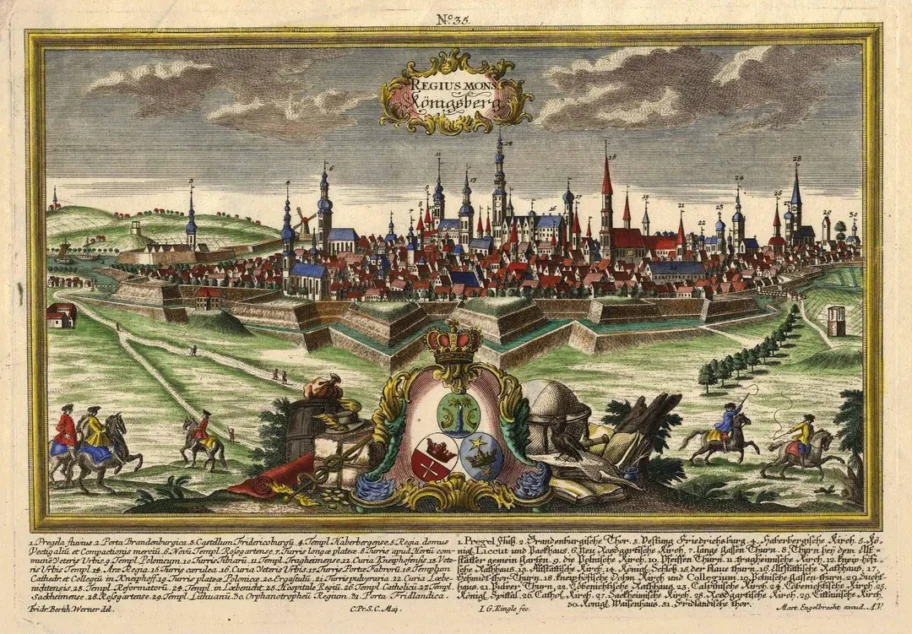
The Prussian city of Königsberg (now the Russian exclave of Kaliningrad), once a nexus for Central European culture and academics, had slowly faded from the view of European society by the 1830s. Immanuel Kant, famed for his groundbreaking rationalist philosophy and consistently timed walks through the streets of the city, was long dead. The mathematician Leonhard Euler’s seven bridges—the subject of a mathematical puzzle about whether one could cross all seven without repeating any crossings (you couldn’t)—still stood, but the city no longer held the cultural influence it had enjoyed at the height of the Enlightenment. Königsberg had most recently held Europe’s attention in the Napoleonic Wars, when Napoleon’s Grand Armée triumphantly left East Prussia for Russia in June 1812, having ransacked the region’s towns and farms. The few survivors of Napoleon’s Russian adventure staggered back to Königsberg in mid-December, decimated by cold, starvation, Cossacks, and Russian partisans.
Königsberg was, by the 1830s, at best a disappointing experience for visitors. The city gates were dilapidated, and the streetscape, with a hodgepodge of architectural styles and buildings with ill-designed makeshift additions and expansions jutting out into the street, was at best unsightly. The Prussian Hegelian philosopher Karl Rosenkranz wrote in 1842 that Königsberg was “the city in which everything exists in a state of almost”—almost a royal residence, an industrial city, a seaside city, and a wealthy city, and yet never fully being any one of these things.
It was in this Königsberg, once but no longer at the crossroads of history, formerly a center of European intellectual life but now a relative backwater, that Johannes Ebel and Georg Diestel were in 1835 criminally accused of starting a religious cult. Christopher Clark’s slim new book, A Scandal in Königsberg (Penguin, 2026), gives a history of a long-forgotten religious trial and describes its role as a microcosm of contemporary European society. Clark, the Cambridge historian known for his World War I study The Sleepwalkers: How Europe Went to War in 1914, discovered the Ebel and Diestel trial in the 1990s and never lost interest. In his foreword, Clark also avers that the media frenzy surrounding the event is relevant to our modern world of mass media.
Ebel, prior to the trial, had preached at Königsberg’s Old City Church and followed the enigmatic theosophist and preacher Johann Heinrich Schönherr, a failed theologian disillusioned by the rationalist philosophy and theology of the era. Schönherr proposed a system far from the rationalist theology taught in contemporary institutions—a theosophy based on the union of two “primal entities” (Urwesen), opposing spheres of water and fire. These two primordial spheres, Schönherr held, melded and gained consciousness at the creation of the world. Schönherr gradually elaborated on this unorthodox story, tying it into selective readings of Scripture and building a dedicated following.
Ebel was one of these followers. Clark notes that few of Schönherr’s followers adopted all of his teachings and that Ebel’s interest in Schönherr’s esoteric teachings “lay both in their cosmic explanatory scope, and in the theosopher’s ability to build bridges—as Ebel saw it—between philosophy and faith.” This interest in Schönherr’s teachings, however selective, put Ebel on the wrong side of contemporary European religious norms, and attracted the ire of German religious authorities. Ebel and Diestel were accused of starting a religious cult that encouraged sexual impropriety, especially among women, and that espoused teachings well outside the period’s highly institutionalized, rationalist religious orthodoxy. Ebel, at the time, was well-connected to Königsberg’s high society, and his sermons drew large crowds. His unorthodox teachings attracted the attention of German authorities, and Ebel and Diestel found themselves accused of “the establishment of a sect whose doctrines lead to vice.”
While Ebel and Diestel had occasionally counseled their followers on sexual matters, such as whether to make love with the lamp on or extinguished (they recommended that couples do it in the light), they denied ever recommending extramarital sexual activity. And, Clark notes, none of the complainants were women. Media sources sensationalized the courtroom accusations, publishing lurid accounts of Ebel and Diestel’s activities that resembled descriptions of other controversial groups. Ebel and Diestel were eventually found guilty of premeditated breach of duty and Ebel of creating an “illegal sect”; both were disqualified from holding office. The accusations of sexual impropriety were not upheld by the court, and the judgment focused on Ebel and Diestel’s deviations from the religious establishment, even though neither had challenged religious authority and both denied promoting Schönherr’s teachings.
One of Clark’s greatest strengths in A Scandal in Königsberg is his ability to connect the individuals and movements within nineteenth-century Königsberg to European society more broadly. In Ebel’s case, his trial roughly coincided with the release of the theologian David Friedrich Strauss’s The Life of Jesus, Critically Examined (1835). Strauss, who argued that the Gospels were not factual descriptions of the divine but rather were historical documents, reflecting how Christ’s contemporaries used “myths” to exalt him, caused an uproar in Europe that Clark compares to the effect of Salman Rushdie’s The Satanic Verses on the conservative Muslim world. Strauss was fired from his seminary position, and conservative Protestants convened “committees of faith” and campaigned against Strauss’s appointment to a position at a university in Zurich. The Strauss case, much like that of Ebel, is itself a representation in miniature of contemporary European society, and Clark does a good job connecting these various phenomena with broader cultural debates over rigidity, institutionalization, and religious rationalism. European society was split between Protestantism and Catholicism but also between the secular and the religious, and, within religious life, between ultra-rationalists and pietist and more evangelical movements.
Another strength is the book’s postmortem of the trial. While Clark does not avoid drawing connections between modern mass media and the media sensation surrounding Ebel and Diestel (as mentioned in the foreword), he wisely leaves these things mostly implicit. When he does mention modern names and concepts, he quickly connects them to the trial and its implications. The investigation and subsequent trial of Ebel and Diestel, for example, were motivated in large part by the polarization of public opinion against them, and the religious authorities frequently described this polarization as something outside of their control. Clark comments, however, that “popular opinion was not the driver of the scandal around Ebel and Diestel but to a considerable extent a function of how it was managed,” and aptly connects the role of the Königsberg body politic in the trial to Jürgen Habermas’s theories about the public sphere. He goes beyond Habermas’s conception of the public sphere as a product of a post-religious, rational, and liberal society, however, and describes how the trial’s publicity was not a product of rational and secular Habermasian virtues but rather a reflection of darker realities about Europe at that time.
More at home than Habermas in Clark’s rich tapestry of nineteenth-century European life are the various figures of the Enlightenment, German idealism, and contemporary religious thought that surrounded Ebel and Diestel’s world. Kant, then and today the most well-known Königsberg philosophical figure, is a necessary inclusion, even if he died some thirty years before the trial. Hegel and his followers come up now and again for similar reasons, and Clark’s thorough description of Schönherr’s unorthodox theology provides a firm grounding for Ebel’s own controversies, even if Schönherr today has faded into obscurity. Other characters include German religious authorities, clergymen and religious figures, and philosophers like Friedrich Wilhelm Joseph Schelling, whose works were likely influential for Schönherr’s thought. Clark draws on a wide cast of characters for such a short book, and it is this rich recreation of the European world between the destructive Napoleonic Wars of the nineteenth century and the cataclysms of the twentieth, that gives an otherwise forgotten trial such staying power.