


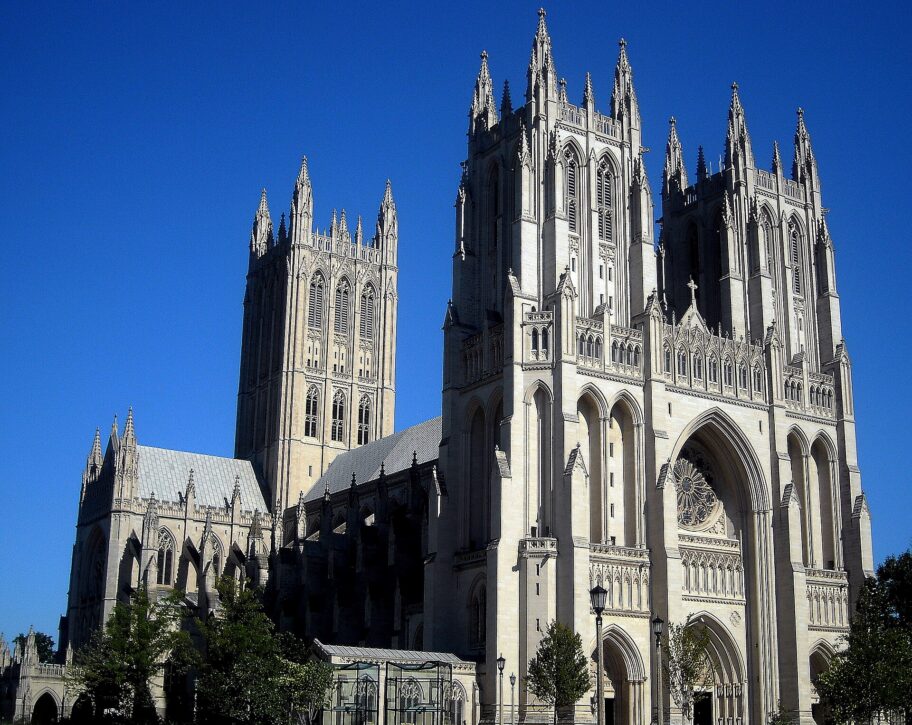
Every couple of years, interest spikes in the “religious left,” a nebulous, hard-to-pin-down coalition of religiously motivated actors involved with American liberal and progressive politics. Since the start of Trump’s second administration, the religious left has been having another moment of visibility: Mariann Edgar Budde, Episcopal bishop of Washington, D.C., confronted Trump during her sermon at the Inaugural Prayer Service; more than two hundred clergy were arrested in one day of protesting ICE in Minneapolis; and James Talarico, a Presbyterian seminarian, is waging a religiously-based, progressive campaign as a Democrat for the U.S. Senate, and just won the Texas Democratic primary.
At the same time, while religion’s decline in the U.S. has plateaued, Roman Catholicism, which was once a major religious force in the Democratic Party, is now roughly split between the two political parties, and mainline Protestantism continues to bleed out its membership rosters
I spoke with Michael Wear about the state of the religious left today. Wear served in the White House’s faith-based initiative during President Obama’s first term, leading evangelical outreach and managing the White House’s engagement of religious and values issues, including adoption and anti–human trafficking efforts. He then became faith outreach director for President Obama’s 2012 election campaign. In 2022, he founded the Center for Christianity and Public Life, and his most recent book is The Spirit of Our Politics: Spiritual Formation and the Renovation of Public Life. This interview was conducted over two separate conversations during a two-day period, and has been edited for clarity and brevity.
Miguel Petrosky: How would you describe the state of faith and politics in the U.S. today?
Michael Wear: That’s a big question. It’s a big question because more of the electorate is religious than anything else: there are more voters who identify as religious than identify as male or female; any race or ethnicity; Democrat or Republican; or really any other meaningful, distinguishing demographic marker. Even more than demography, religion is culture, it’s values, it’s worldview, it’s heart. I think an argument could be made that it’s more salient and more contested than it has been in decades.
In some ways, this moment reminds me of the post-2004 moment, when Democrats lost sort of unexpectedly and controversially in 2000 to George W. Bush. In 2004, if you were in a liberal echo chamber, you just sort of thought, “Surely the country is not going to elect this guy twice.” Progressives thought he was disqualified by the way he talked, by the religious associations he kept and professed. There was concern about “theocracy” then, not unlike the rhetoric around “Christian nationalism” today.
In 2024, just as in 2004, Democrats ran a campaign that was largely indifferent—if not antagonistic—to religious discourse and constituencies, except to use conservative religiosity as a kind of foil. And in 2024, just like in 2004, Democrats lost. Unlike in 2000 and 2016, the losses they faced the second time around were so convincing that comforting stories of rigged elections and misjudged communications strategies were not sufficient to prevent a serious conversation within the party about its future. Faith was central in both periods—post-2004 and post-2024—as the Democratic Party sought to recalibrate.
What is different today is that in the Bush years, Democrats generally granted the Bush-era GOP’s claim to religion, to being the party for “values voters.” It’s untenable to give deference to such a claim when that party chooses Donald Trump as its leader. Donald Trump has renewed Democrats’ sense of their own morality. Democrats do not just believe there is a political judgment to be made about Trump, but a moral judgment. Democrats look at Trump and just viscerally reject the notion that this Republican Party is the party of values, of morality. The party has been forced by circumstances into rediscovering a moral critique that it had, with mixed political results, with Adlai Stevenson, George McGovern, Jimmy Carter, and Jesse Jackson.
This rediscovery opens the door to, and creates a hunger for, candidates like James Talarico. With Talarico, it’s not so much that his message and approach is new, but that he has met a particular kind of moment. If you look through a religious or sociological lens, he’s totally recognizable as a sort of 1980s-era liberal mainline Protestant. He’s very open about how influential his pastor is, and even some of the arguments that sound novel to some people are the kinds of arguments that you hear in liberal seminaries and in intellectual, progressive, mainline environments. To talk about religion so directly has definitely not been the mainstream of the Democratic Party of late, but a progressive religious or Christian articulation is not something that needed to be invented out of whole cloth.
MP: I was talking to a scholar yesterday about Talarico. I think you’re right—he’s not novel in the sense of a faith-based articulation of politics from the left side. I guess the only thing that’s novel about him is that in the Democratic Party, you have clergy who run for office, like Raphael Warnock for Senate, Jesse Jackson for president in the 1980s. Especially in the Black church, there is a history of pastors getting into progressive politics. That’s just very natural. It seems like the novelty of Talarico is that he’s a white person who’s running as a faith-based candidate.
MW: I mostly agree with you. There’s a well-established, church-to-public-service pipeline, infrastructure, and model career path in the Black church that the progressive white mainline hasn’t necessarily cultivated as much. I think part of what also makes it different is that James [Talarico] is so young and has made his way in a Democratic Party, which for his entire adult life has been on the other side of the God Gap. Talarico, though, is deeply concerned with Christianity in America.
Now, that sometimes gets him into real trouble, because he has a specific religious interest and can sometimes talk as though he’s batting around ideas with other seminarians. His invocation of Mary, Jesus’ mother, in his argument for abortion rights on Joe Rogan’s show is one of those arguments that you make if you’re a young, progressive seminarian. There is a range of theological, political, and substantive problems with that argument—I disagree with it on every level. He’d have been better off not making the argument.
But what I haven’t seen observed—and this is a really important insight, I think—is that Talarico gives that answer on abortion because he invokes religion for many of his other positions. It reminded me of Barack Obama writing about the dissatisfaction he felt following his debate with Alan Keyes in 2004. After being pressed by Keyes and the moderator, Obama resorted to saying that he was running to be the U.S. Senator from Illinois, not a pastor. Obama was dissatisfied because it was a conventional political answer—one that the current president also uses, by the way—that elides saying what you actually believe and support.
Obama was decidedly not a seminarian. Talarico, on the other hand, gives that answer because he speaks so consistently about religion, and there would be a disconnect if he didn’t make an argument as to how his pro-choice views are consistent, in his mind, with his faith. Because what he doesn’t want to indicate is, “My religion only takes me this far, but then I become a politician or then I become a Democrat.” He doesn’t want to say the issue of abortion is “above my pay grade.” Because he’s so invested in offering this different vision of Christianity and politics—one, I must say, I am not entirely on board with—he gives an answer that isn’t just a political provocation, but one that explicitly refers to Scripture as justification.
MP: That’s a good point. When I think of people who are in the Democratic Party in the past several decades—at least post–Roe v. Wade—who were not even necessarily religious but certainly had some faith background, particularly, I think of Mario Cuomo’s speech at the 1984 Democratic Convention—one that set the standard for how faith-based, pro-life (and predominately Catholic) Democrat politicians operated within the DNC. He made the case that he’s a Catholic and holds certain beliefs, but he doesn’t offer any theological justification. He essentially says, “My faith disagrees with this, but my faith doesn’t dictate public morality”—he didn’t run his politics and campaigned solely on religion in a way that someone like James Talarico has. To your point, what I think is interesting is that, because of Talarico’s strategy of running a faith-based progressive campaign, it almost requires a faith-based justification for every position. It’s a double-edged sword that could potentially come back to him in a negative way.
MW: This is the exact temptation when you combine faith and politics. This is what C.S. Lewis argues in “Meditations on the Third Commandment,” that when you enter as an identifiable Christian voice or into a Christian political party, you aren’t just talking about the things that you want to talk about—you are forced to talk about a whole set of issues that are confronted with, and if you’re not careful, you risk claiming, as Lewis would say, “God hath said when he hasn’t spoken.”
The Republican corollary of this would be the faith voter guides that would go in churches, where it would be about abortion and religious freedom, but if the Republican Party was also running that year on the repeal of the estate tax, for instance, that issue would also get included as a litmus test issue on a voter guide that was ostensibly using faith, not politics, to set the criteria.
Another thing about Talarico that folks miss is that while it’s unclear what kind of appeal he’ll have to some significant percentage of religious Republicans and independents, his appeal in the context of the Democratic Party is now unquestionable. It’s not just that he was appealing to religious Democrats, but to non-religious Democrats who relished hearing religious arguments against Republicans. When Talarico talks about religion with [Ezra] Klein or Rogan, it’s largely positive and personal. But I sensed that for some of his staff, and what his campaign was communicating through his social media accounts, what made it okay for Talarico to invoke religion was that it was to critique Republicans.
MP: The religious left seems to have two aspects: electoral and activist. I’m thinking more recently about clergy and faith-based activists who were involved in anti-ICE protests in Minneapolis and around the country. What role do you think the religious left—or Christian faith-based actors in progressive politics—play in these protests? Are their effects actually impactful, or is it more, as some critics on the political right might argue, that their presence serves mainly as an aesthetic surrounding progressive politics?
MW: I think the first thing I would say, and this goes back to my earlier point, is that this conservative critique of progressive Christianity is longstanding. In many ways, the critique hasn’t really changed. What is different is the perceived viability of Christian support for Donald Trump. When people talk about the aesthetic nature of progressive religious political involvement, we actually see, in many ways, a kind of imitation—despite all of the disavowals from one side against the other.
What’s important for people to understand is that, yes, we have seen some political sorting in American churches, but there are still many churches and denominations that people would consider “progressive” or “mainline” that contain a lot of politically conservative members—and vice versa. I think we do ourselves a disservice if we only look at religion through a political lens, because that’s not how many people actually experience their congregations or their religious lives.
People are looking for grounding for the moral impulses they feel in relation to this political moment. I think the futility of mere personal assertion is more deeply felt now. The politics of identitarian self-assertion is not proving to be as rich a resource for sustaining long-term political involvement as people once thought.
Even with secularization, it’s striking that religious voices still emerge in key moments. When many elected officials seemed to be scrambling and unsure how to respond to the moment—reevaluating what they believed versus what seemed politically advantageous—it was a mainline bishop who stepped forward and said something that resonated and broke through and galvanized people’s attention, at least on the left.
So I do think that progressives are looking to religion as part of their response to this moment, and in ways that arise, at least in part, from an earnest desire to draw on a source of meaning that gives them something to stand on—something more than simply asserting that their political views are better than those of the Trump administration.
MP: I used the term “aesthetic” mainly because—at least compared to the Republican Party—there’s a common assumption in discussions of religion and politics that the GOP has a very large and influential religious voting bloc, especially among evangelicals, whereas what we call the religious left does not have the same level of electoral weight. So in that sense, progressive politics doesn’t necessarily need religious voters—or even moderate religious voters—in the same way. That’s what I was trying to get at when I used the word “aesthetic.”
MW: I don’t think that’s right. First, when you’ve lost the White House, the Senate, and the House, it’s not wise to be thinking about the voters you can shed, rather than those you can add.
Second, while it’s clear that a higher percentage of Republicans identify as religious than Democrats, the majority of Democrats are religious. Tens of millions of religious Americans vote for Democrats in every national election, most of them Christians. This idea though, that Democrats can afford to lose religious voters, is not uncommon. Even among people in decision-making roles on political campaigns. It’s nonsense. I literally don’t know what it means. And the fact that Democrats have run candidates who act like it is the case—who run campaigns as if they believe it to be true—is indicative of a serious and profound problem.
Now I do understand and agree that on the left religious voters can be treated aesthetically, as one constituency out of many that should be “represented.” I do think that can be a problem, but I wonder if it might be part of a broader observation or critique regarding how a certain kind of progressive politics relates to voters generally.
And just to return to this point about the imitation we’re seeing, of the undermining of conservative critiques of the “cultural Christianity” of the left, I just don’t know how much more aesthetically religious you can get than the Trump Bible, or that ridiculous DeSantis ad from the 2024 campaign, an ad that was shamelessly reprised in the service of Trump during the same campaign.
MP: Religion, over the past several decades, has generally been declining, although recently it seems to have plateaued—at least according to research from the Pew Research Center and others. However, we still see that many of the Christian traditions associated with the Christian left, especially mainline Protestantism, are declining in membership and church attendance. Catholicism, which used to be strongly associated with the Democratic coalition—especially from the late nineteenth century through much of the twentieth century—became more divided after Roe v. Wade and is now roughly split between the two parties. Meanwhile, progressive evangelicalism does not seem to be much of a viable force anymore, or at least that’s debatable. So in what ways do you think these trends affect—or do not affect—the impact of religion on politics and culture in the United States?
MW: I would say that it is not healthy—politically, socially, and in most contexts theologically—for one political party to be perceived as the party of genuinely religious people and the other to be viewed as opposed to religion. The incentive structure that creates in politics leads to very dark places very quickly.
I say that not primarily as someone concerned about electoral outcomes, but as someone concerned with the social fabric of the country, the basic legal and political safeguards of our system, and the perception of the church and of Christianity. Christianity claims to stand for something ultimate—something that transcends politics rather than being subsumed by it.
Right now, in various parts of our political life and across the political spectrum, Christianity is too often viewed either as useless or as something to be used. It’s very important that we reject both approaches: the utilitarian, transactional use of religion and the attempt to make or treat religion as irrelevant.
MP: It sounds like you’re saying that there’s a danger of there being a religious left and a religious right.
MW: Absolutely. I think the general election in Texas is going to have a lot of “you can’t be a real Christian if…” kind of rhetoric.
Now, I would not argue that we do not want religious people showing up on the left and right of our political spectrum. I think the argument would be more about being very cautious about acting as if the faith can be summarized and adequately represented by any one political expression. That would be my discomfort. Christianity should never be reduced to servicing any narrow ideology.
More specifically to the dangers facing the left today, I think there’s this danger on the religious left of simply utilizing religious language to condemn whatever it is that the Trump administration is doing this week. I’m not trying to say that’s true of all the religious left all the time, and I’m also not trying to say that there are no permutations of that on the right, of course. But I think what American voters are looking for, and certainly what our faith demands, is an authenticity of conviction that is not mere reaction. Democrats, Republicans, Christians, atheists—this is a time for figuring out what we really believe. This has been a decade of political destruction. We can rebuild, but it needs to be grounded in a set of affirmations—in positive knowledge of what is good, true, and beautiful—not reactions and antipathies.