



Over the past fifty years, white Christians have shifted decisively to the right. That shift is not isolated to white evangelicals (which most people know about), but is also evident among white Catholics. Increasingly, to be white and Christian is to support the Republican Party.
That was not always the case. For younger adults, it can be difficult to imagine a religious world that was not dominated by the religious right. However, if we take a peek at the partisan composition of white Christians in 1972, as far back as we can go, we see a different political landscape.
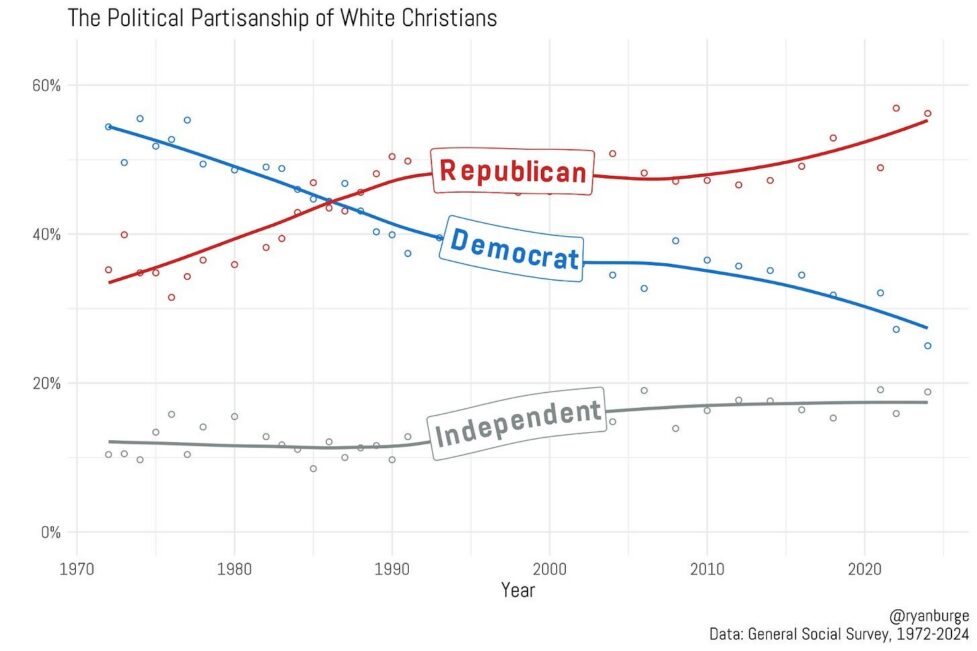
In 1972, a clear majority of white Christians, regardless of their denominational affiliation, were Democrats. To contemporary audiences, that finding is often surprising. It is important to note, however, that these were not Democrats in the modern sense. Many were Southern Democrats (often called Dixiecrats) who felt a sense of alliance to the party because of Franklin Roosevelt’s New Deal policies but held incredibly regressive views on racial issues. By 1980, the share of white Christians who identified as Democrats had dropped below 50 percent.
By the late 1980s, white Christianity was nearly evenly divided between Democrats and Republicans, but that equilibrium proved short-lived. Moving into the 2000s, the Republican ascendance was already visible, hovering around 50 percent. There was a brief period of relative stability through about 2010, but from that point forward the two parties’ trajectories headed in opposite directions. In recent years, white Christians have become more politically unified around the GOP.
From a social-science standpoint, there are only two ways to explain such a shift. One is called generational replacement. If the Dixiecrats were dying off while their children entered adulthood as more Republican-leaning, the aggregate trend would shift rightward. The second possibility is that white Christians simply began to change their minds over time about politics over time. Those same Dixiecrats may have realized that they could no longer support the Democratic Party, were won over by politicians like Ronald Reagan, and then started voting for the GOP.
Distinguishing between these possibilities is essential to understanding how white Christianity became aligned with the Republican Party. One way to explore those possibilities is to do a cohort analysis of white Christians over time. Here, I am replicating the prior graph, but this time I am breaking it down into the four most recent generations (excluding Gen Z, for which the available survey years are limited).
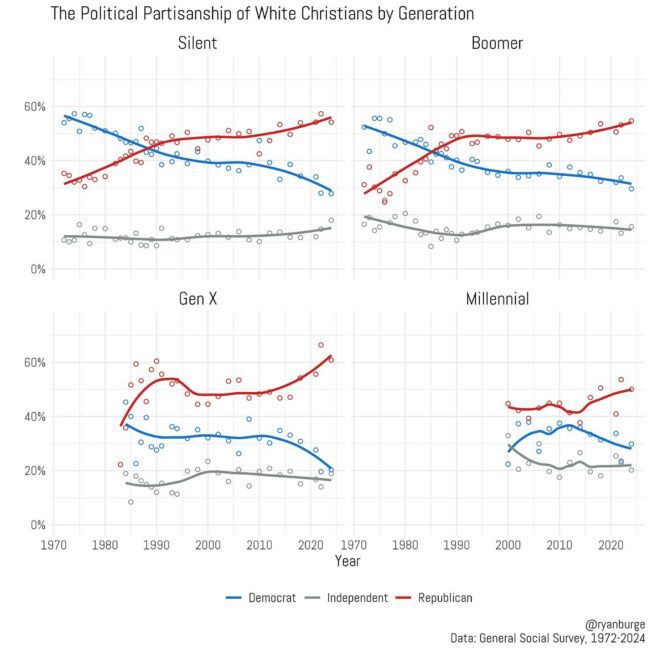
This graph provides clear, compelling evidence to bolster the second theory under consideration: the reason for the white Christian shift toward the Republican Party is that a whole bunch of people just happened to change their minds at nearly the same time. How do we know that? The trend lines for the Silent Generation and Baby Boomers closely mirror the broader population pattern. Democrats were ascendant in the 1970s, but by the late 1980s the lines had begun to cross. For the next couple of decades, the Republican line held steady around 50 percent, but then began to rise again after 2010. That’s essentially a carbon copy of what we saw in the full sample with every age group included.

For Gen X and Millennials, we obviously can’t trace their timeline as far back as the older generations. There is no clear “crossover” moment that we can really discern, although you can kind of see it when looking at the mid-1980s for Gen X. However, both generations of white Christians have been plurality (if not majority) Republicans for the last 35 years. They appear to have come of age when the connection between white Christianity and the GOP was already well established, and they just fell in line.
That’s an important point to note, and something I want to visualize in a simpler way. If you look at the “entry point” for the younger generations of white Christians, you see that they come into adulthood with a much more Republican-leaning outlook than their parents or grandparents.
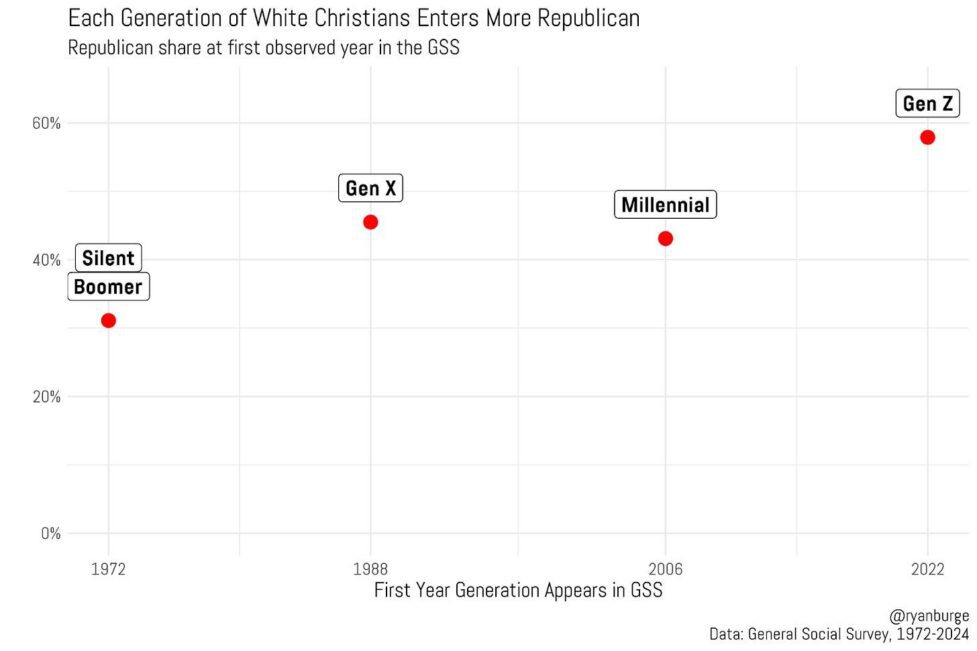
When Gen X entered the sample in large enough numbers around 1988, 46 percent identified as Republican. In 1972, when we have the first year of data on Boomers, only 31 percent were Republican. Millennials begin showing up in the data with a decent sample in 2006, when about 43 percent of them identified as Republican.
Generation Z presents a particularly striking example. Although the oldest members were born around 1996, we can’t really compile a decent sample until 2022 or so. But when they start showing up in the data, 58 percent of them are Republican, essentially the same level of GOP allegiance that Baby Boomers have now. The idea that younger white Christians are more politically diverse is simply not empirically supported.
The Cooperative Election Study, a second dataset with a larger sample through a shorter timeline, allows for these patterns to be examined with greater precision. First conducted in 2008, this study includes sample sizes that are often twenty times the size of the General Social Survey. Instead of looking at generations (which often span 15 years), the data can be organized into five-year birth cohorts. Restricting the sample to white Christians and white non-religious people allows for a more detailed look at partisan change over time.
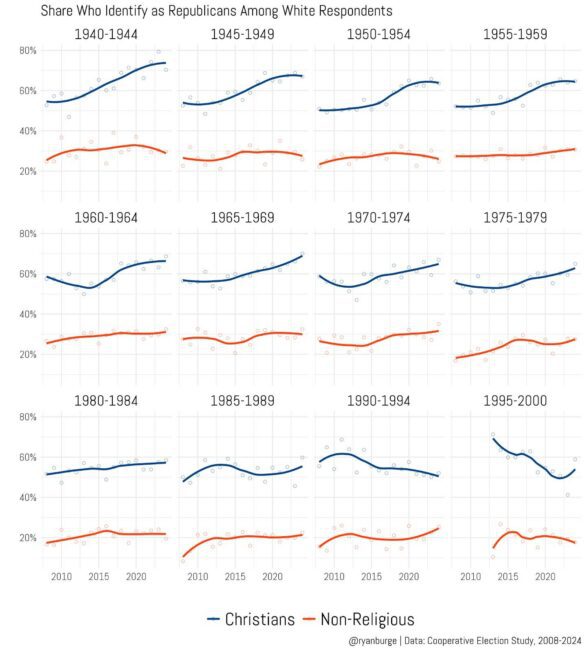
What we are really looking for here is the trajectory of the lines—we want to be able to discern if there are “in-cohort” changes in political partisanship. When it comes to white Christians, you can most definitely see such changes by looking across the top row of graphs. Their movement toward the GOP is stunning to consider, given that we are only looking at a timeline that goes back sixteen years. Among white Christians born in the early 1940s, a bare majority were Republican in 2008. By 2024, that figure had risen to about 70 percent. You can see that the inflection point for many in this cohort is right around the time Donald Trump was first elected to the White House.
If you take a look at the second row of graphs, you can also see that 2015 or 2016 is a clear demarcation point. In the last ten years, there’s evidence that white Christians in Gen X have moved toward the GOP as well. The shift is measurable, though it’s not nearly as dramatic as with older groups represented in the top row.
The bottom row is not so simple to describe with a broad brush. It does look like older, Millennial white Christians have drifted to the right, but that’s not really replicated among younger generations. In fact, among white Christians born in the 1990s, they have actually moved away from the Republican Party in the last ten years.
Let me simplify this by showing you the two endpoints for this time series: 2008 vs 2024.
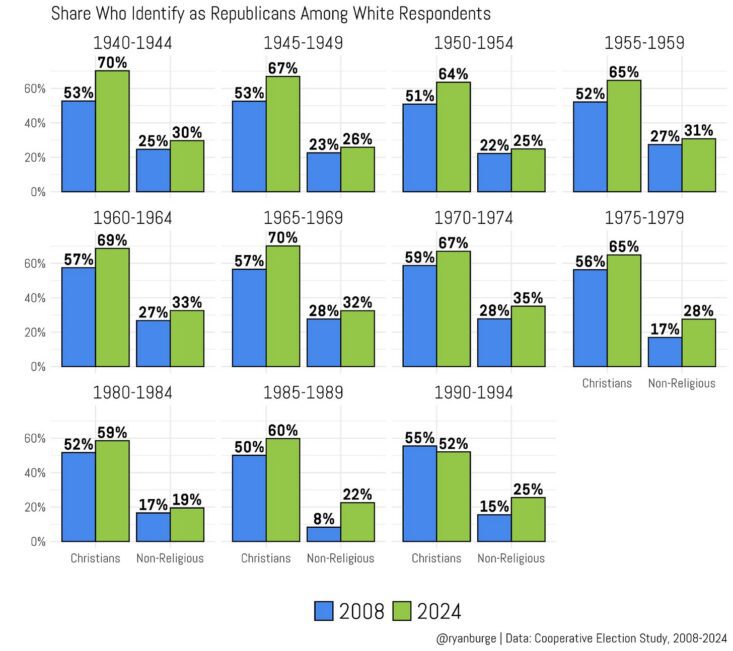
In this data, you can see those huge Republican spikes among older white Christians in this data. For the early 1940s cohort, it rises 17 points. But, to be fair, the jump across the top row is all double digits. In fact, the GOP gained at least ten percentage points among white Christians in every birth cohort from 1940 all the way through 1969—so that’s a lot of white Christians in Gen X who have shifted significantly to the right since 2008.
Younger cohorts of white Christians have experienced measurable changes, too. Among those born in the early 1970s, alignment with the Republican Party increased by eight points, and, among those born between 1975 and 1979, nine points. With the exception of the youngest cohort, the white Christian vote has shifted toward the GOP by no less than seven points among any age group.
I have intentionally left out a really interesting finding, though—one you may have picked up on if you carefully looked at the other part of this analysis: what happened to folks who claim no religious affiliation? Yes, white Christians have shifted to the right over time. But guess what? So have some white non-religious folks.
In fact, there is not a single birth cohort in this entire analysis where the nones have not become more Republican between 2008 and 2024. The size of the movement is smaller than it is among Christians, but it’s still notable. In many of these cohorts, white non-religious Americans are 4 to 8 percentage points more likely to identify as Republican today than in 2008.
In other words, white people—regardless of religion—have become more Republican since 2008.
But it is worth zooming in on that finding just a little bit. For it’s really one specific type of none that has warmed up to the GOP: “nothing in particulars.”
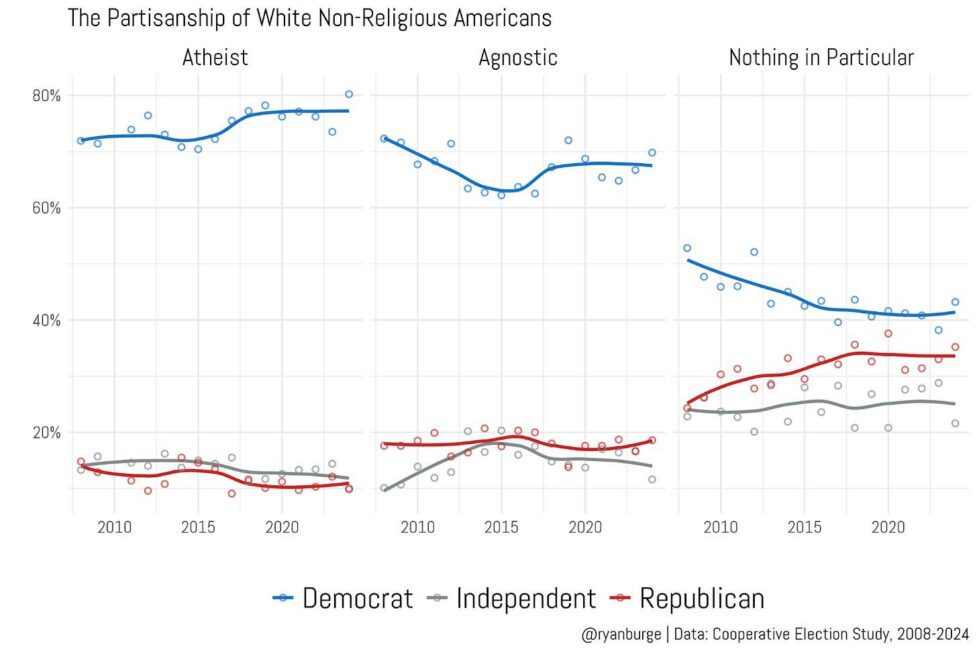
Atheists are strongly aligned with the Democratic Party. Agnostics are slightly less Democratic-leaning, but it’s still about 70 percent of them in 2024. But look at those “nothing in particulars”—that’s what is moving the aggregate number in the prior graph. In 2008, about half of them identified as Democrats. By 2024, that had dropped to just about 40 percent. Meanwhile, the GOP share rose from 25 percent to 35 percent during this same period.
Why is this group so consequential? Because they are enormous in number. Nearly one in five Americans describes their religion as “nothing in particular.” That ten-point movement could yield more votes for the GOP than anything happening among atheists and agnostics, simply because there just aren’t that many atheists and agnostics.
So, what have we learned here? First, the white Christian shift toward the GOP is more about people changing their minds than about generational replacement. That conclusion is exceedingly clear from this analysis. Second, the GOP gains have not been limited to Christians. There’s good evidence here that white non-religious folks have also shifted toward Republicans over the last fifteen years. This is a story not just about religion—it’s also deeply intertwined with race. The Republican Party’s grip on white America is strengthening, regardless of whether they go to church or not.