


I was looking at my high school yearbook the other day. Don’t judge me. It’s something that people who grew up in small towns do on a regular basis when they see something on Facebook about someone roughly their age who is being arrested or has died. Sometimes I can’t remember if I went to school with that person, so off to the yearbook I go.
I started thumbing through the first couple of pages and found a layout that featured my graduation from Salem Community High School. On one page, there was a nice picture in the bottom corner featuring me and six other guys from my high school friend group. That got me thinking about where all of those fellas ended up. All seven of us still live in Illinois, and I still talk to a few of them.
Then I started counting. Of the seven, three have no biological children. One has just one kid. Two of us have two kids, and one guy has three. Seven guys and eight kids. Since we are all in our mid-forties now, I can confidently say that this group of graduates from the class of 2000 is not going to reach replacement fertility level. This is obviously one of the biggest shifts in American life over the last couple of generations—young adults aren’t having kids.
Most surveys are not particularly good at digging into the reasons why people aren’t reproducing anymore. However, we have a great new addition to the discourse about fertility: Pew has posted its “American Trends Panel Wave 147” on the Association of Religion Data Archives. The first line of the summary tells the whole story: “The purpose of this study is to discover why people choose not to have children, exploring factors like career, finances, world concerns, or personal choice.”
Now, the full sample does contain younger adults who said they were unlikely to have children, but I excluded them from this analysis. Instead, I restricted the sample to people who were at least fifty years old and had never had children. Put simply, for nearly everyone in this group, childlessness is likely to be a permanent life-course outcome.
These folks were asked to describe their thoughts on having children and were given three primary response options: there was a time when they wanted kids, they never wanted children, or they weren’t sure if they wanted children. I broke this sample down into four of the larger religious traditions: Protestants, Catholics, the unaffiliated (the “nones”), and those from other faith groups.
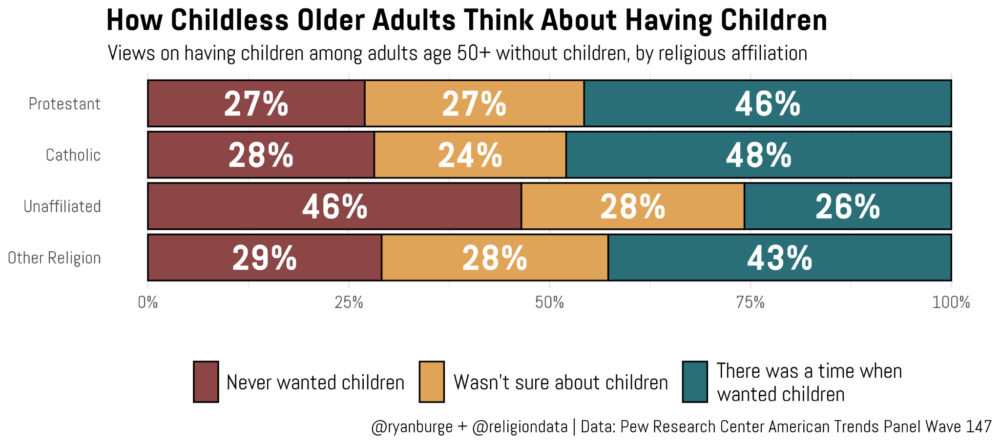
It’s important to note that in the full sample, the most popular response was, “There was a time when I wanted to have children.” About four in ten people with no kids who were at least fifty years old chose that option. People from religious groups scored above that average, however. For Catholics, it was nearly half (48 percent), and Protestants were in essentially the same spot, at 46 percent.
The huge outlier in the data is the religiously unaffiliated. Among this group, only a quarter said there was a time in which they wanted to have children. For the nones, the most popular option by a long shot was, “I never wanted to have children.” This sentiment captured 46 percent of the non-religious, which was nearly twenty points higher than any other religious group.
This huge divergence is something I am going to spend the rest of this essay trying to sort out, because it’s not a small difference.
The Pew survey contained a battery of questions investigating why respondents never had children. It included options like negative family experiences as a child, not finding the right partner, and “you just didn’t want to.” Here is the share of each tradition that listed each as a “major reason” for not having children.
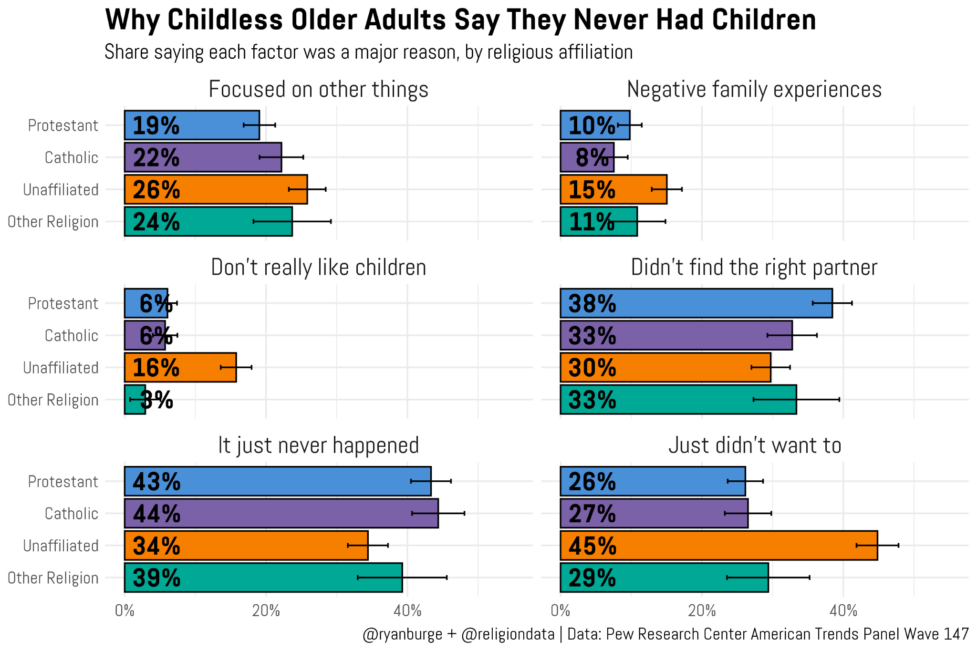
Here’s where things get a lot muddier. The whole battery contained ten items; I chose to only visualize six here, but I can’t find many examples where these religious traditions differ significantly from each other. For instance, the question about negative family experiences didn’t reveal much. Among Catholics, 8 percent indicated it was a major reason for not having kids, compared to 15 percent among the non-religious. That is a difference, for sure, but not a huge gap.
One thing that does seem to emerge is that the nones were never that inclined to have kids. Only 30 percent of them said a major reason for their childlessness was not finding the right partner—about five points lower than religious respondents. Only 34 percent of the nones said, “It just never happened,” which was about ten points lower than the Protestants and Catholics in the sample.
The two comparisons that jump out are “don’t really like children” and “just didn’t want to.” For the former, 16 percent of the nones gave this as a major reason, compared to 6 percent of Christians. On the latter item, 45 percent of the nones indicated they just didn’t want to have kids—nearly twenty points higher than Christians.
This goes back to the first bit of analysis: the nones are much more likely to say, “I never wanted to have kids.”
I was also intrigued by questions focusing on life satisfaction. If the nones chose to be childfree, while many religious folks didn’t have kids because of circumstances, it stands to reason that older Christians would feel less satisfied with their lives.
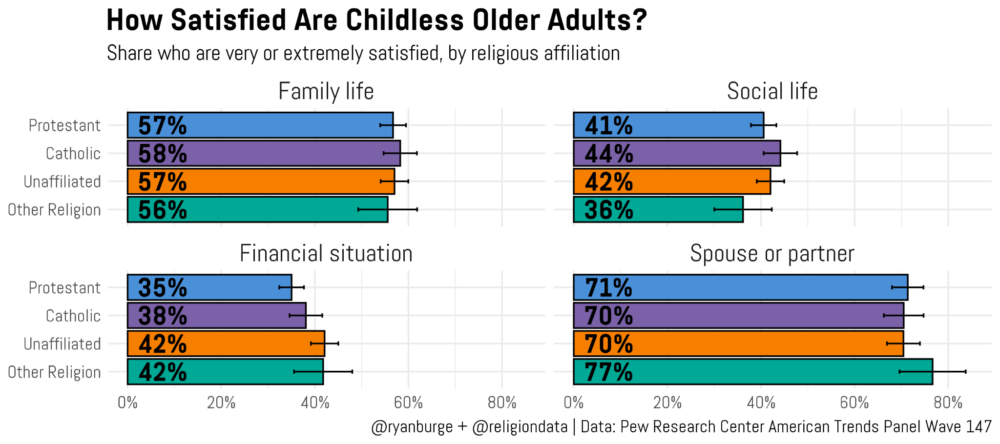
I don’t see that theory borne out by these results. For instance, among all four groups, the share who said they were very or extremely satisfied with their family life was statistically the same, hovering around 57 percent. The same is true regarding their social life, where each group is right around 40 percent. On questions about their financial situation and spouse or partner, you don’t see a huge gap either.
To me, this lack of difference is actually quite interesting. Remember that many childless older Christians wanted to have kids, whereas that wasn’t the case for the nones. But despite ending up in the same situation later in life, both groups seem to have come to terms with their circumstances. I don’t see any evidence that people whose circumstances worked against them are feeling less satisfied than those who made a conscious choice to be childfree.
There were also a handful of questions asking respondents to reflect on possible anxieties as they age. For instance, how much did childless folks worry about having someone to take care of them as they got older? Another gauged concern about being lonely in old age.
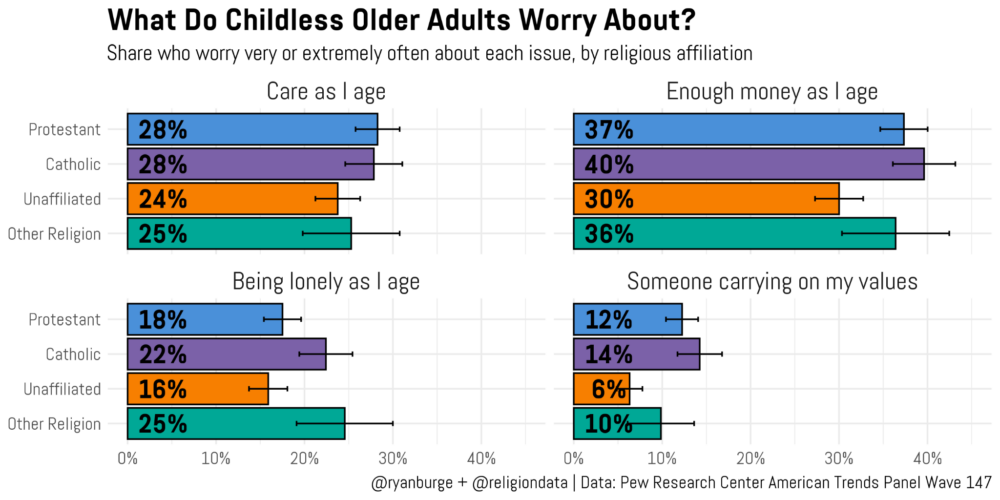
The overall impression I get is that older non-religious folks without kids don’t seem too concerned with these possibilities. For instance, only 16 percent were very or extremely worried about being lonely as they aged—six points lower than Catholics. Only 6 percent of the nones were worried that they wouldn’t be able to carry on their values to the next generation. Those figures for Protestants and Catholics were 12 percent and 14 percent, respectively.
In fact, there’s not a single instance in this data where a none expressed more concern than a Christian. Given how the discourse often goes, this is interesting. When someone mentions they don’t have kids, a common response is, “Who is going to take care of you in old age?” That question just doesn’t seem to land for the nones; they don’t stress about it. And childless Christians don’t seem to be ruminating on this too much, either, with fewer than 30 percent indicating it’s a significant concern.
That question about loneliness got me thinking about other familial connections. For instance, maybe they have strong relationships with nieces and nephews? I know many families that have the “fun uncle/aunt” who visits a few times a year for a night out or a shopping trip.
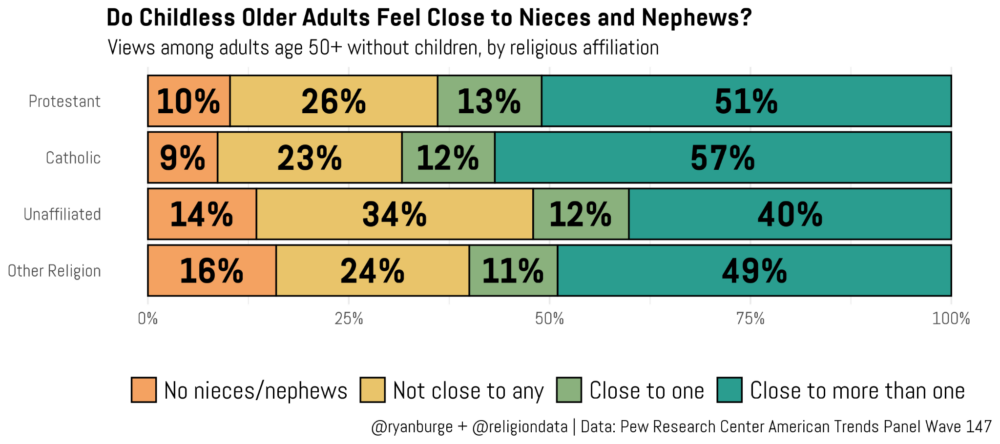
This anecdote is supported somewhat by the data. Among older childless Christians, a majority say they have a close relationship with more than one niece or nephew. For each group of religious respondents, at least 60 percent reported a strong bond with at least one niece or nephew.
For the non-religious, only 40 percent said they had multiple strong ties to nieces and nephews, and just a bare majority (52 percent) had a close tie with at least one. About a third of the nones said they didn’t have a strong relationship with any nieces or nephews, which was about ten points higher than the rest of the sample.
It feels like the non-religious are “further away” from children compared to those who identify with a religious tradition. The nones were much more likely to say they never wanted kids, they don’t seem to have lower life satisfaction as older adults, and they aren’t as concerned with how childlessness will impact them as they age.
Looking through this data, I had a hard time reaching conclusions. I couldn’t put my finger on a single reason why the nones were never inclined toward children. So, I built a regression model that included various demographic controls and political ideology. I hoped to better understand the causal factors for why the unaffiliated just don’t want to have kids.
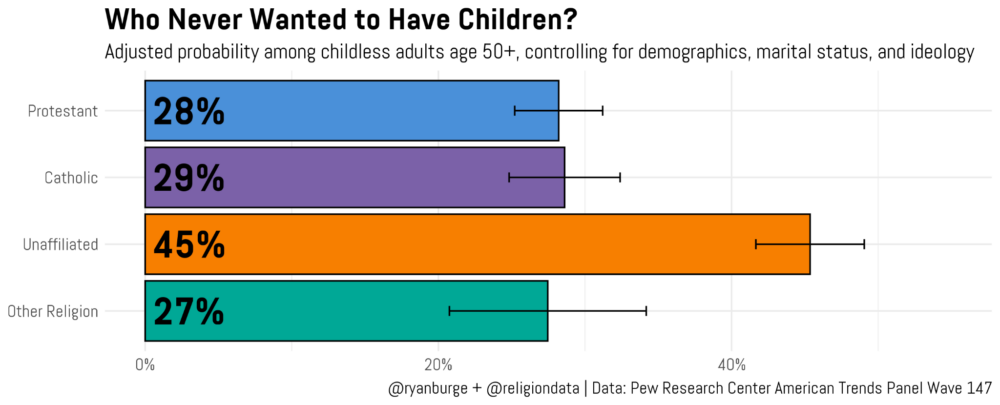
And guess what? Even after controlling for nearly a dozen factors, the “I just didn’t want to have kids” gap remains incredibly persistent. The predicted probabilities indicate that 45 percent of the nones simply never had any desire to have children. For Protestants, Catholics, and those from other faith traditions, the model pegged this response at 27–29 percent of each subgroup.
This is often the frustration we face in social science: we want to clearly identify why people chose a different path. When it comes to having kids, almost half of the nones just shrug their shoulders and say, “That’s not for me.” And if I talked to my three high school buddies about why they never had kids, I bet they couldn’t articulate a single solid reason.
And this data suggests their experience is not unique.