


Last fall, I received an email from Planned Parenthood of Greater New York. The subject line read “Your Stories Have Power,” and inside it thanked those who had spoken out in support of the organization when Trump’s spending bill defunded it. Sharing your story, it said, “takes power away from our opponents to make up their own false realities about what it means to destroy access to reproductive and sexual health care.”
I haven’t ever received care from Planned Parenthood, but five years ago, at the age of 48, I sought an abortion. At a women’s health center where a doctor who had been recommended to me had moved his practice during the pandemic. In the end I did not need an abortion: on the day of the appointment, an ultrasound showed that what I’d thought I’d been carrying inside me for eight weeks had probably stopped living at six weeks, right around the time I’d taken the pregnancy test. A D&C was then administered to remove the expired fetal tissue.
I’ve had real trouble describing what happened as a miscarriage or a pregnancy loss, given how detached I thought I should remain, mainly out of self-protection, from the life I’d decided to erase. And how silently it exited. So I would like to say that I have an abortion story—or a kind of abortion story—to tell. And even though I’ve longed to tell this story, and even though I am a registered Democrat who believes abortion should absolutely be a human right, I have no interest in sharing this story with a reproductive rights organization. I do not think they would find it very useful.
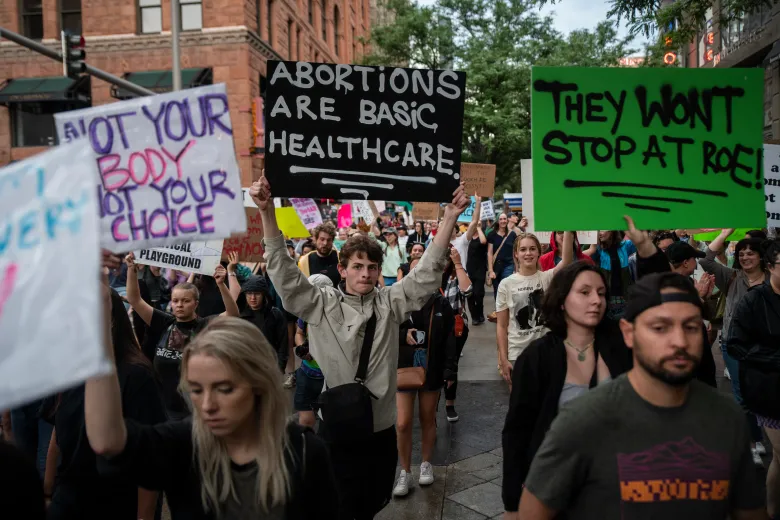
My experience wasn’t traumatic, so it can’t be used to shame the public into enlightenment or action. And it hasn’t exactly left me feeling like I triumphed over patriarchal power structures, so it can’t be used to affirm the certainties fueling all the slogans–like Abortion is freedom or Abortion is health care or Bans off my body or My body, my choice–that presume to speak for me. It’s merely sad—or so I think.
It’s also possible that this story might sound a note of treason. The abortion that wasn’t an abortion confirmed my sense that the language we abortion rights supporters are asked to use is an insufficient, if not incorrect, description of what the procedure used to end a pregnancy can entail.
I discovered I was pregnant in August of 2021. My boyfriend at the time loved me, as did the state of New York, which had made it so that I did not have to drive five hundred miles to get an abortion, or worry about being arrested for seeking one. Excelsior! like it said on the state seal affixed to the entrance to the Brooklyn-Battery Tunnel. I knew I should have been feeling nothing but elation upon making the appointment, especially given the fact that Texas was about to pass SB 8, which would prohibit abortions after the detection of a fetal heartbeat.
But at 48, there were more regrets than there were things to celebrate, and having to end this first and only pregnancy—one that I thought would probably end itself, considering my age—now numbered among them. If I’d met my boyfriend in my thirties—but I hadn’t. He was ten years older than me, divorced, and already a father.

I had not intended to be unmarried at this age, and while I’d never really wanted to be a mother, with a few other lifelong ambitions remaining stubbornly unrealized, I’d started to wish I’d had children. Children would have justified my existence and enlarged my heart. Or so I imagined, and didn’t think I was wrong. A certain strain of feminism would have had me shouting the abortion I planned to have, but I wasn’t in the mood.
Upon leaving the clinic, I would be even less in the mood. The girls at the front desk were not overly impressed by the fact that they were front-line providers of what the side I was on liked to call abortion care. They seemed more interested instead in making it clear it was our fault they’d had to get up and get on the subway that morning. We weren’t heroes for showing up there, said the almost performative lack of kindness shown to nearly every woman they checked in, and neither were they. This clinic was a business, said their indifference, just like any other.
I took a seat in the packed waiting room and wondered whether my desire for more kindness was justified, or whether I deserved to be labeled what we were calling a Karen, or worse. I wanted kindness because I believed what I was there to abort was more than just a fetus—had everything been different, it might have one day taken the shape of me at 13 or my aunt at 13 or my boyfriend in infancy or my boyfriend asleep.
There were about 15 other women in the waiting room that morning, and all of them appeared to have drained their faces of emotion. But a girl sitting a few chairs away from me—skinny, glasses, wearing pants and a t-shirt that had politely excused themselves from all style whims—could not be silent. She had curled in on herself within the confines of a chair and was crying. Crying and moaning. There would of course have to be one crying girl in this waiting room, the way there always seemed to be that one wildly inconsolable kid on a flight you did not particularly want to take. No one in the waiting room did anything about it. No one in reception did anything about it.
Her tears were loud and frightened and forced the gap between rhetoric and reality to grow conspicuously large. We are being lied to, I thought but did not want to think. The Right was right, I thought, and really did not want to think, when they accused the side I was on of engaging in some euphemistic rebranding with the slogan Abortion is health care. Not because abortion was in fact murder. But because this claim about abortion’s safety and necessity also made a claim about its emotional price tag: you shouldn’t feel a thing either physically or psychically. And yet here this girl was.
The girl had curled in on herself within the confines of a chair and was crying. Crying and moaning.
Her tears reminded me that placing bodily autonomy at the center of this fight obscured some truths that probably sounded too much like right-wing propaganda to admit into the discourse. Such as: abortion involved the heart just as much as, if not more than, the body. It involved the part of us that was desperate to be cherished, protected, and comforted. To be told we weren’t made entirely of mistakes. The part that wanted what we shouldn’t and more than we had, and broke when it could not reconcile dream with reality.
My heart had led me to this waiting room. Longing and desire for another human had put me here. My body had merely been the means of articulating that longing and desire, and once my body no longer carried what he and I had made, it would just be me and my heart again, walking around the city, trapped in a body that felt entirely too autonomous.
What would Planned Parenthood, or any other reproductive rights organization I had ever donated to, say to this girl in the waiting room? That the realization of bodily autonomy was its own reward? What could I say to her? That there was no reason to cry or be afraid because having a legal abortion in America was much safer than actually giving birth in America? I was sitting there wanting to cry, too.
We were a stupid country and I had lived a stupid life. But I was not going to cry, and I did not want to be angry at Planned Parenthood or any other reproductive rights organization. They had helped make it so that these women and I could sit in relative peace as we waited for our names to be called. Was it worth disturbing this peace to attempt to console this girl? We were in a room full of women, myself among them, who seemed—almost grimly?—determined to make this whole thing go faster through maintaining a self-possessed silence, and I didn’t want to be the one to break the spell we were trying to cast. I was pretty sure I would only embarrass the both of us if I did.
Unlike the receptionists, the nurses were kind—especially the nurse who told me that, according to the ultrasound, the pregnancy had ended itself. Even though I knew this might happen, it was still distressing to hear. Also kind: the surgeon, the anesthesiologist, and the physician’s assistant who administered the D&C that would remove what my body had decided to extinguish before I’d had the chance to.
Technically, then, no one could accuse me of murder. But learning at the last minute that I’d lost this pregnancy rather than electively terminated it was beside the point. Discovering at the last minute that my body had made the decision to abort this child did not free me from the regret that had come with having to make the decision in the first place. It did not change the fact that I had made a choice to end a pregnancy and had spent the last two weeks and a few long hours that morning wrestling with how, as an abortion rights supporter, I was supposed to understand both the choice I had made and what I had carried inside me.
None of the privileges I possessed—my job flexibility, relative financial stability, being in love, living in New York, all of the reproductive health information I’d gathered in my years as a fact-checker—could keep me from walking out of that clinic charged with a politically unproductive, and even politically dangerous, ambivalence. I was relieved to no longer be pregnant; I longed to be pregnant still. I loved my boyfriend; I hated him for already having given a child and so much else to a woman who did not deserve it. I was fall-down-on-my-knees grateful to everyone who had ever fought to keep abortion legal; I was irate at the slogans and the rhetoric and how little room all of it made for real life. For disappointment, regret, self-recrimination, and sorrow. I did not feel guilty but I did feel sad.
Two people walked out of the clinic that day: the woman who suspected she might be heartbroken, and the abortion rights supporter who worried that if she said out loud that she might be heartbroken, she might be willfully misunderstood by other supporters as secretly or not-so-secretly conservative, or crypto-Christofascist, or feminist in name only. The woman who suspected she might be heartbroken wondered if she had a right to her own interpretation of this experience or whether she should sacrifice her critique to a silence that might be more conducive to, or suggestive of, complete solidarity.
A few weeks later, on an early October day as warm as summer, I decided to attend an abortion rights rally at a park next to City Hall. By that point my ambivalence had given way to conviction: now was perhaps not the time to privilege the personal over the political. Being that I had walked into and out of that clinic without fearing for my life, I owed this movement more than my money, and I wanted to start defending it in a more public and committed way.
So I listened to speeches and music in the hot sun for a few hours, until I grew uncomfortable standing in the middle of a crowd that had no problem holding a bunch of exhausted oversimplifications up high above their heads. They in fact seemed to be waving them around with almost gleeful self-congratulation. I wondered if the deep crank gathering within me meant I was going to have to stop calling myself a feminist. The way I’d had to stop calling myself a Christian when the clichés had piled up too high and affirming the groupthink seemed more important than affirming the gospel.
Two people walked out of the clinic that day: the woman who suspected she might be heartbroken, and the abortion rights supporter who worried that if she said out loud that she might be heartbroken, she might be willfully misunderstood as feminist in name only.
I decided to leave when I saw a piece of poster board wanting to remind us that the right was getting all worked up over a clump of cells. I’d heard that one before, of course, but that day it hit different, as we now like to say. That sign, if people I loved had seen it, would probably confirm their belief that most abortion rights supporters were heartless amoral relativists who thought abortion was no more onerous than a pedicure. At that moment, I wasn’t sure that I’d be willing or able to argue them out of that impression. I was too pissed myself at what sounded like hyperbolic heartlessness and pride taken in that heartlessness. At detachment being held up yet again as the most incontrovertible proof of liberation.
It was impossible for me to think of what I had chosen to abort as just a clump of cells. I did not want to dismiss my pregnancy, however brief and untimely, that easily or with that level of hostility—or, frankly, that level of stupidity. That hostility, which was masquerading as scientific accuracy, was asking me to hate not just the right and its hysterical sentimentalism, but to hate what my body had created. I couldn’t.
I respected it—it should have never existed at all, and yet there it was—and I could not help but be curious about it, could not help but mourn it. It was not just a fetus. It was my first and last chance to bring the best, and even the worst, parts of my father, my mother, my grandparents, my aunts, and myself into the world. I should not be disqualified from having strong feelings about it just because I had decided to abort it.
I considered walking over to the person holding the sign and asking them what they would say to me if I told them I wanted everyone who needed an abortion to be able to have one, no questions asked, yet was insulted by their contempt for what had lived inside me. That bid for dialogue, or confrontation, would, I imagined, probably achieve the same amount of nothing as their sign, so I continued toward the subway.
One person’s clump of cells, I thought on the train home, might be another person’s fading constellation of wished-upon stars.
Nearly five years have passed since that rally. Four have passed since the overturning of Roe. Scarcely a day has gone by without NPR or the Guardian or the Times bringing me news of the horrifying lengths the right will go to keep women pregnant. Such as widening the war on abortion to include among their targets expectant mothers. The D&C I received without incident in New York has been withheld from miscarrying women in Texas and other states because the procedure is the same one used for abortions–it’s called an abortion when you need to remove something living from a uterus and a D&C when you need to remove what’s no longer alive. Hospitals do not trust state governments to believe that staff did not use it to terminate a viable pregnancy. At least two women have died as a result. And now my fellow Americans have for the second time installed a man in the White House who, while he may privately think abortion is no big deal, is more than happy to take credit for stacking the Supreme Court with the justices who made the overturning of Roe possible.
And yet, despite being routinely made sick by the right’s relentless vengeful war on women, I remain almost as furious with the side I am on, because it requires those of us who believe in abortion’s moral legitimacy to also believe that what is aborted has no meaning or weight.
Because the right insists that we feel too much about it, we on the left have to give up feeling anything about it. Because the right says abortion stops a beating heart, we excise the heart from the narrative. Because the right insists that what’s lost in abortion and how it’s lost is worthy of the name murder, we on the left must insist that abortion involves no loss at all. Because the right’s preferred register is lurid sentimentalism, the left’s register is almost exclusively clinical. Because the right loves to weaponize regret and ambivalence as proof that abortion is harmful to women, we on the left are reluctant to admit that abortion results in anything other than relief and gratitude. All of which suggests to me that we on the left may be more preoccupied with defending ourselves against the misconceptions of the enemy than with giving an honest account of what the exercising of this freedom actually looks and sounds like.
Abortion is the decision to end a life at its very beginnings because an existing one and its commitments or ideals count more. I don’t think this means abortion is murder, but I do think this means it’s a matter of life and death. Literally and figuratively. It does not have to be registered as such by everyone who makes this decision, but neither should everyone who makes this decision feel they must pretend this is not what is at stake.
Something dies in abortion, and whether you call it a clump of cells or a fetus or a child, the result is that the tiny human siphoning all your energy away even in those very early stages of pregnancy will cease to biologically function. Some dreams you have may die then, too—dreams of who you thought you were or could or should be. And in the extinguishing of the beginnings of a life, we may be forced to reckon with what we ourselves have done with our own finite number of days and with whom we have spent them.
I’m not sure what would happen if the messaging changed to be more reflective of these complexities. All I know is that I no longer feel comfortable donating anything more than my money to reproductive rights organizations. This refusal costs the movement nothing, but me quite a bit: the discomfort of being a person who can’t get over herself enough to ferociously fight one of the most important moral battles she is aware of, and at a crucial juncture. I am failing other women, I sometimes think, in choosing to remain more loyal to my pain and to my objections. But intellectual sovereignty is as important to me as bodily sovereignty.
My sadness—and I often still feel it—doesn’t mean abortions shouldn’t happen. It means that abortion may not, for some of us, be merely health care, or essential, or freedom, as all the signs in brownstone windows and tote bags on the subway and graffiti in bathroom stalls keep reminding me. I am not saying that everyone has to be as bummed as me about making the decision to have an abortion. No. I want Lily Allen, for example, to be able to laugh over the fact that she can’t remember whether she had four or five of them. But true reproductive freedom might look like the ability to demand both the right to erase the beginnings of a life because you believe your existing, long-established one counts more and the right to mourn that loss as hard as a woman who thought her only destiny was to create a family, even if you thought you never wanted one. In the meantime, I offer these sentences.