


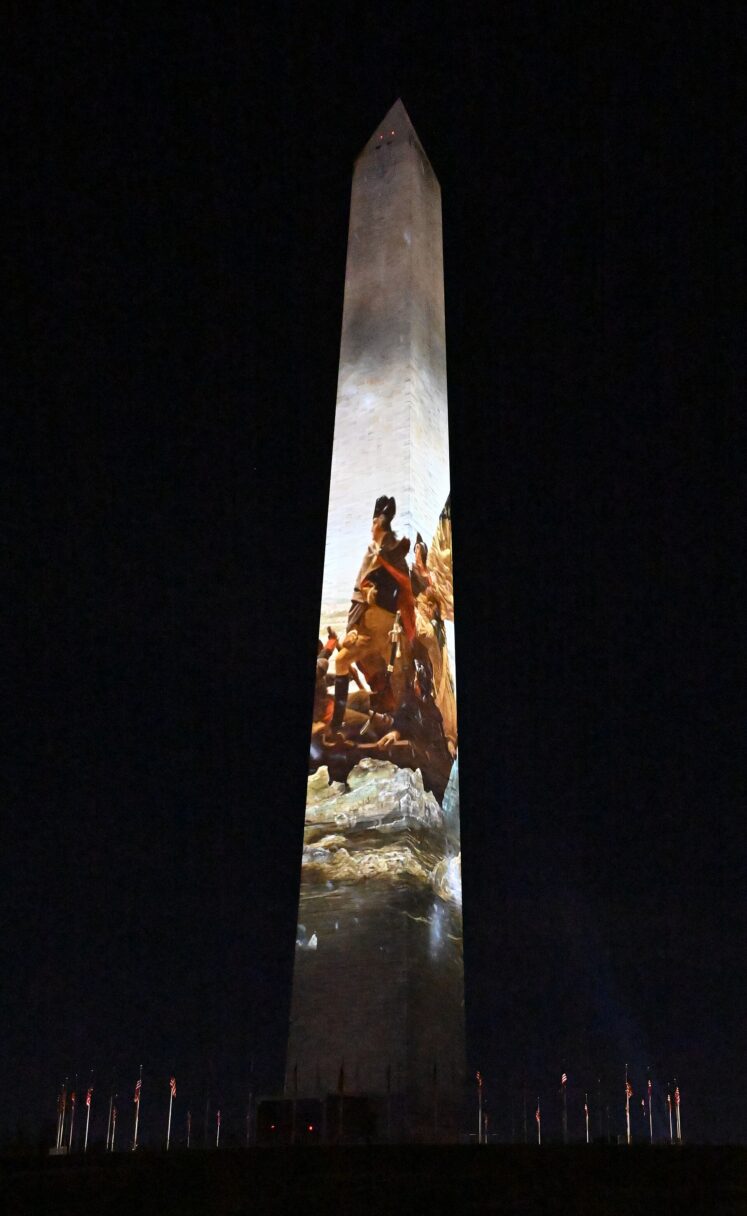
Am I the only one who feels like this year’s Semi-Quincentennial—as we are to call the country’s 250th birthday—is being a little under-celebrated? I was only two years old when we last had a big old national b-day celebration, in 1976, but in my imagination it was a non-stop huge blowout, something straight out of Richard Linklater’s brilliant homage to the summer of 1976, Dazed and Confused: a big party, good intoxicants, up all night (up all year?), good times had by all. This year, by contrast, it seems like nothing is happening. Where are the commemorative stamps? The tall ships? The once-in-a-lifetime fireworks?
But I went and did some research, and instead of the research confirming my suspicions, it instead schooled me. It turns out, you see, that I am wrong on all counts: wrong about 1976, wrong about what’s going on in 2026.
First, about the last big national party, for the Bicentennial. It’s true that there were a lot of festivities, and what’s more, the party started early. In 1975, a year of festivities kicked off with something called the American Freedom Train, which took off from Wilmington, Del., and spent the next year visiting the contiguous 48 states. Also in 1975, Gerald Ford, the president, lit a lantern in historic Old North Church, playing the part of Paul Revere. Come the actual birthday, in July 1976, there were indeed epic fireworks. There were tall ships in New York harbor. There was a parade in Washington, with Johnny Cash as the marshal.
But the Johnny Cash bit should alert us to the underbelly of the celebration: at its heart, it could be a bit corny. I mean, Johnny Cash was great and all—but as the head celebrant of two hundred years of the greatest country on earth? Should we be surprised, then, that the celebration also included a Washington-crossing-the-Deleware reenactment, complete with period-costume reenactors (in November 1975); the Bicentennial logo stitched on the uniforms of both teams in the Super Bowl (Cowboys and Steelers); and—didn’t you know?—endless TV specials, hosted by titans of the arts like Bob Hope, Raymond Burr, and Paul Anka?
In other words, what transpired in 1976 wasn’t a solemn, serious, reverent testament to liberty and freedom; it was a somewhat haphazard assemblage of notions, some good (the stamps were beautiful), some a bit lame.
And that’s exactly what we’re getting this year. Although I didn’t know it—information is so fractured these days, a lot of news slips past us all—the tall ships are returning to New York harbor. There are mighty fireworks displays coming across the country, including to a town near you, wherever you are. And the United States Postal Service is once again delivering us some pretty sweet birthday stamps (check out the curation by Ralph Lauren). No, our president isn’t exactly offering the rousing oratorical tributes we would hope for—but then again, neither did the silver-tongued Gerald Ford.
If it’s true that there seems to be a bit less going on this time around—how is it that the NFL, the most patriotic of leagues, has done so little to add to the celebration?—it’s also true that there really wasn’t so much of note back then, either. And maybe we shouldn’t be surprised. We’re in a bit of a national funk, but in 1976 the country was barely out of Vietnam and was still mired, psychologically, in the Watergate scandal. Good times, those weren’t.
With all that said, I’m a sucker for a party, and I do think it’s incumbent on all of us who think about America and its history to mark the Semi-Quincentennial somehow. And so I was thrilled that Washington University in St. Louis, Arc’s institutional home, commemorated the year with a boffo lecture series this past spring titled 1776: Then and Now. The lectures, which were open to the public, were delivered by an august group of scholars drawn from the university and around the country. One week, our own Leigh Eric Schmidt addressed the question of whether the revolutionaries were secular or religious; another week, Princeton’s Eddie S. Glaude Jr. spoke about the legacy of the Revolution; one week, Tazeen Ali talked about Thomas Jefferson’s Qu’ran.
The whole series of lectures is available for viewing here. For now, I invite you to watch Harvard professor Danielle Allen discuss the ongoing importance of the Declaration of Independence. This Saturday will mark 250 years since that remarkable document was signed. All of us who live with its promises, fulfilled and not, should give thanks, in whatever way we can. Learning a bit more about the document, and the Revolution to which it gave birth, is one such way.